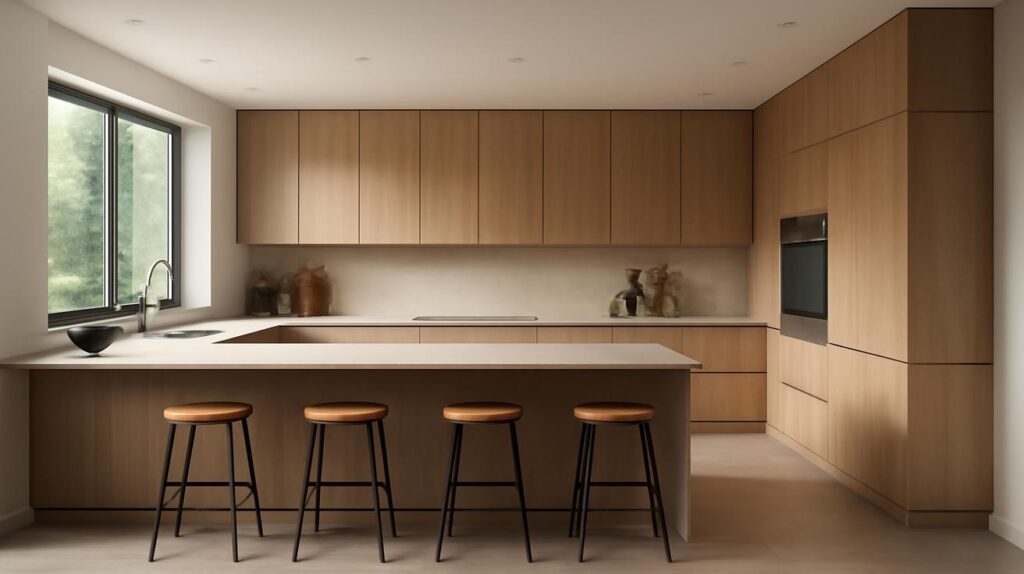
The first time I noticed it, I was standing in a quiet house in late afternoon light, listening to the soft hum of a refrigerator and the distant sound of traffic outside. The kitchen felt… different. There was no hulking block in the center of the room. No big, immovable kitchen island dominating the space like a parked SUV in a small garage. Instead, there was flow. Light poured across the floor uninterrupted. A slim, graceful counter stretched from the wall and curved gently into the room, like a river changing course. A slim cart stood nearby, half bar, half pantry, ready to roll wherever it was needed. The space felt alive, flexible, and strangely calm. And I realized: this is what’s quietly happening in modern homes everywhere. We’re saying goodbye to kitchen islands—and what’s replacing them is more practical, more elegant, and far more in tune with how we actually live.
The problem with the kitchen island we all thought we wanted
For the last two decades, the kitchen island has been the crown jewel of the “dream kitchen.” Granite-topped, waterfall-edged, lit with pendant lights, and often big enough to be seen from space, the island became our status symbol and our stage.
We gathered around it for hurried breakfasts, holiday buffets, laptop marathons, and awkward small talk with guests while pasta boiled and bread warmed. Real estate listings shouted, “Expansive kitchen island!” as if the presence of one was proof that a home was both luxurious and practical.
But slowly, the cracks began to show—metaphorically and sometimes literally. People started to notice how much space a fixed island steals, especially in modest or mid-sized homes. Walking around it with groceries got old. Two cooks tried to dance around each other and collided in the bottleneck between island and counter. That big, beautiful block of stone began to feel less like a dream and more like a boulder in a river, forcing everything around it to work harder to get where it needed to go.
Our lives changed, too. We work at home more. We entertain differently—less formal, more fluid, more “grab a plate and wander.” We cook in waves instead of sprawling three-hour marathons. The kind of kitchen that works best for that life looks less like a stationary stage and more like a flexible studio. And so, as 2026 approaches, a quiet revolution is underway.
The peninsula and the moveable kitchen: the new heart of the home
The trend that is already reshaping modern kitchens isn’t just about one new object replacing another. It’s about a shift from “fixed and centered” to “fluid and responsive.” The star of this shift is a pairing: the kitchen peninsula and its agile sidekick, the moveable work cart.
The peninsula isn’t exactly new—it’s been around for decades—but the way designers are treating it now feels fresh. Instead of a short stub of counter jutting awkwardly into the room, the modern peninsula is more like a slender bridge. It often extends from one wall or cabinet run, creating a gentle boundary between kitchen and living space while keeping sightlines open. There are no hard corners forming a square prison; instead, forms are softened, tapered, or rounded, letting people move smoothly around them.
Beside it, or sometimes nested under it, is the moveable kitchen cart: a slim, beautifully designed piece on lockable casters that can serve as prep station, bar, baking center, or buffet table depending on the day. Together, the peninsula and the movable cart quietly do the job that the island once did—but with far more grace.
The peninsula advantage: elegant, space-smart, and social
Think of the peninsula as the kitchen’s open arm rather than its center of gravity. It doesn’t block traffic; it guides it. It lets you stand at the stove and still chat with someone perched on a stool at the far end. It gives you a place to serve snacks toward the living room side while keeping the messy prep zone a little more contained on the kitchen side.
Peninsulas naturally work well in smaller or open-plan spaces because they can hug the room’s edges rather than claim the middle. They make it possible to have the counter space you crave—room for chopping vegetables, plating dinners, lining up ingredients—without locking the whole family into single-file movement patterns.
In many 2026 kitchen designs, the peninsula is getting softer. The sharp right-angled corners of the early 2000s are fading, replaced by curved ends, chamfered edges, and organic shapes that feel inspired by streams, branches, and shorelines. It’s subtle, but your body notices. You brush past without bruising a hip. You lean into it, not away from it. You perch there with a glass of wine and a bowl of olives, and it feels like being next to a welcoming boundary, not a barricade.
The moveable cart: the small, quiet revolution on wheels
Maybe the most exciting part of this new kitchen era is the moveable cart. The best ones don’t look like the clunky microwave stands of the 1990s. They look like carefully crafted furniture: solid wood or powder-coated steel, slim profiles, integrated cutting boards, sometimes even induction burners built into the surface.
These carts slip under or alongside the peninsula when not in use, almost vanishing into the architecture. But when you need more space—Thanksgiving, cookie baking day, cocktail party, science project with the kids—they roll out like an extra pair of hands.
You can drag one next to the stove to hold ingredients and pans, then wheel it out to the patio door to become a drinks station under the evening sky. You can roll it beside the dining table and let it serve as a dessert cart, or line it with plants and fresh herbs when you’re not cooking at all. Instead of insisting that everything in the kitchen adapt to a single fixed centerpiece, this new approach gives you a shape-shifting companion.
How the new layout changes the way a kitchen feels—and works
Stand in a kitchen with a peninsula and moveable cart and notice the difference in your body. Your shoulders feel less tense. Your path from sink to stove to fridge isn’t interrupted by a solid block; it’s a simple arc. Kids can zoom through the room without being scolded for “cutting the corner around the island.” Guests can linger along the edge of the kitchen instead of clogging its center.
This isn’t just about walking paths. It’s about roles and atmosphere. With a large island, there’s usually one “performance” side—the side facing guests—and one “working” side where trash bins, mixers, and splatters accumulate. Someone ends up being on display, like a food show host in front of an audience of barstools.
With a peninsula, people often naturally gather along the outer curve, turning the working side into a cozy nook instead of a stage. Conversation flows diagonally instead of face-off. There is often more eye contact with the rest of the room, less feeling of being cornered by cabinets and stone.
The cart amplifies this sense of choice. If you want extra space, you invite it into the center. If you crave openness, you park it against the wall or slip it away. It’s like having a door you can open or close in a room that used to be fixed in one mode forever.
| Feature | Traditional Island | Peninsula + Moveable Cart |
|---|---|---|
| Space usage | Occupies center of room, often demanding larger footprint | Hugs edges; opens up center and adapts to small or medium spaces |
| Flexibility | Fixed; cannot grow, shrink or move | Cart moves, peninsula can vary in length and shape |
| Social flow | Creates a “front stage” and “back stage” feel | Encourages side-by-side and diagonal conversation |
| Cleaning & maintenance | Large single surface, hard to reach all sides in tight rooms | Smaller planes; cart can be rolled out for easy cleaning |
| Aesthetic | Visual weight; can dominate the room | Lighter, more open, emphasizes lines, curves and views |
Designing your own post-island kitchen
If you’re staring at your current kitchen and wondering how you might join this new wave, you don’t necessarily have to gut the whole room. The beauty of this trend is that it’s as much about intention and layout as it is about shiny new finishes.
Step one: Question the center
Begin by standing in your kitchen and watching how you move. Where do you naturally pivot? Where do you get stuck? If you already have an island, notice how often you walk around it simply to reach something that could be directly in front of you in a different layout.
Ask yourself: if this large block in the center disappeared, how would the room feel? Where would daylight flow? Where would people naturally gather? Sometimes, simply imagining the absence of the island can reveal the possibilities: a longer run of counter along the wall, a peninsula that doubles as a breakfast bar, or a more generous path between kitchen and living space.
Step two: Let the room shape the peninsula
A good peninsula feels like it grew out of the room’s bones. Maybe it starts as an extension of the main counter, turning at a soft angle instead of a rigid right angle. Maybe it grows from a column or pantry wall, reaching into the open space just enough to define zones without closing them off.
In narrow rooms, the peninsula might be shallow and long, providing a line of stools facing outward. In wider rooms, it might sweep into a slight curve. Light wood tones, rounded corners, and slim, open supports keep it feeling airy instead of blocky. Storage can be tucked beneath in the form of drawers accessible from the kitchen side, while the living-room-facing side stays clean and simple, like a piece of furniture.
Step three: Choose a cart you’ll actually love using
The moveable cart is the secret engine of this whole setup. Choose one as thoughtfully as you would a dining table or a sofa. It should feel like an intentional object, not an afterthought. Think about:
- Height: It should align comfortably with your counters or be just a touch lower for kneading dough and detailed prep.
- Surface: Butcher block for warmth and cutting; stone or metal for easy cleanup and pastry work.
- Storage: Open shelves for baskets and bowls, or closed cabinets if you prefer visual calm.
- Wheels: Lockable, smooth, and sturdy enough to feel stable when fully loaded.
When not in heavy use, the cart can slide alongside the peninsula, acting almost like an extension of it. On busy days, it becomes the extra pair of hands that a fixed island can never be.
Why this shift feels so right for right now
There’s something deeply aligned between this design shift and the way our lives have changed in the last few years. Our homes have become offices, classrooms, sanctuaries, and sometimes refuges. We ask more of every room—and especially of the kitchen, that endlessly hardworking heart of the home.
A big, immovable island belongs to an era when we imagined life as a kind of show: dinner parties with everyone perched in one place, staged countertops, glossy surfaces that signaled success. Today, success looks quieter and more personal. It’s the ability to rearrange your space on a Tuesday afternoon when you need a Zoom-friendly backdrop and a place for the kids to roll out pizza dough at the same time.
The peninsula-and-cart layout understands that life flows. It says: let the kitchen adjust to you, not the other way around. It makes space for small moments—a late-night tea with a friend at the curved end of the counter, a messy baking day that expands and contracts as needed, a solo breakfast with sunlight pooling over a slim bar facing the window.
And it gently reconnects the kitchen with the rest of the home. Without a bulky island walling things off, conversations drift more easily. Movement feels intuitive instead of choreographed. You feel less like you’re working at a station and more like you’re inhabiting a living landscape of wood, stone, light, and air.
From island envy to thoughtful simplicity
If you once dreamed of a huge island, you’re not alone. Many of us were conditioned to think that bigger, bulkier, and more central meant better. But trends evolve for a reason. They shift when we collectively realize that something else simply feels better to live with.
In 2026 and beyond, the most admired kitchens won’t necessarily be the ones with the largest slabs of stone in the middle. They’ll be the ones that feel effortlessly usable: where every surface has a purpose, every path feels open, and the space can bend, just a little, to whatever the day asks of it.
You might still see islands in new homes, of course. But more and more, you’ll notice something else: a graceful peninsula defining the edge of the kitchen, a slender cart waiting in the wings, a room that feels at once grounded and free. It’s a quieter kind of luxury—one that measures success not in square feet of stone, but in the ease with which you can make a meal, host a friend, or simply move through your day.
Maybe the island had its time. It taught us that kitchens matter, that they deserve center stage. Now, this new wave of design is teaching us something softer and wiser: that the best stage is the one that can change scenes as often as life does.
FAQ
Are kitchen islands going completely out of style?
No, islands aren’t disappearing entirely, especially in very large kitchens. But their dominance is fading. Designers are increasingly favoring peninsulas and flexible elements because they work better in a wider range of homes and lifestyles.
Is a peninsula better than an island for a small kitchen?
Usually, yes. A peninsula can hug the edge of the room, freeing up the center and improving circulation. It offers similar counter space to a small island but with less visual and physical bulk.
Can I convert my existing island into a peninsula?
In many cases, yes, especially if your island already sits close to a wall or cabinet run. A designer or contractor can often reconfigure cabinetry and utilities to extend the counter to the wall and reshape it as a peninsula.
What if I really love the look of an island?
You can still achieve a similar feel with a peninsula and a well-chosen cart. The peninsula provides the anchor and seating; the cart adds function and flexibility. Together, they can deliver island-level usefulness without locking your room into a single configuration.
How do I choose the right size for a peninsula?
Start from your room’s circulation. Ensure at least about 90 cm of clear passage around it (more in busy households if possible). Then size the peninsula for the tasks you do most—seating, prep, or serving—and let those needs guide its length and shape.
Will this layout hurt my home’s resale value?
Current buyer preferences are shifting toward open, flexible kitchens. A thoughtfully designed peninsula and moveable cart are increasingly seen as smart, modern choices, especially when they improve light, flow, and usability.
Can this trend work in a closed or galley kitchen?
Yes. In a galley or partially closed kitchen, a peninsula at one end can open the room toward a dining or living area, while a slim cart can tuck away when not in use. The same principles of flow and flexibility still apply—just on a more compact scale.