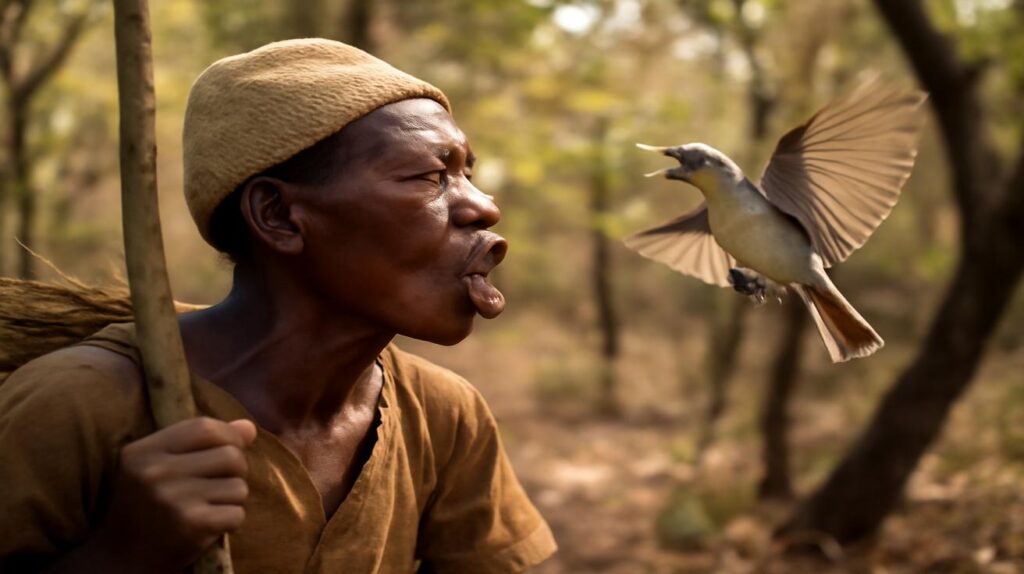
The man stops at the forest’s edge and cups his hands around his mouth. The morning air is cool and damp, heavy with the sweetness of wild blossoms and wood smoke drifting from unseen villages. Birds trade notes in the canopy, leaves whisper against one another, and somewhere—hidden in the green distance—a thin, urgent whistle cuts through the soundscape. The man whistles back, a throaty trill that lifts, drops, then snaps off sharply at the end. Silence, for three heartbeats. Then the answer comes: a rattling chatter like pebbles poured into a hollow gourd. The conversation has begun.
When a Bird Becomes a Partner
In the forests and miombo woodlands of northern Mozambique, some people do not hunt for honey alone. They go with birds.
The bird is small and plain to an untrained eye—a greater honeyguide, all soft browns and cryptic markings, with a pale chest and sharp, bright eyes. It looks like any other creature that might flick past you and disappear. But to Yao honey hunters in these landscapes, the honeyguide is not just another bird. It is an ally, a specialist, a co-worker. And between hunter and bird, there is a spoken language—one that shifts subtly from region to region like accents in distant towns.
Walk with a honey hunter at dawn and you will feel it. The air hums with potential, with the slight nervousness of a search. The hunter moves quietly along dusty paths, past cassava fields and charred stumps where last season’s fires licked through. He listens for that specific call—dry, rattling, insistently directional. It is the bird advertising its services: I know where the bees are. Do you want to come?
But what waits beneath the bark, in the hollow of a baobab or in a crevice of rock, is dangerous treasure. Wild bees do not give up their honey gently. The partnership with honeyguides is not whimsical. It’s practical, built on generations of listening and pattern, on an understanding that each partner wants something different from the same golden prize.
How to Call a Bird That Calls Bees
For the honey hunter, the first move is an invitation. In northern Mozambique, among Yao communities, that invitation has a sound: “brrrr-hm.” It begins as a rolling trill, deep in the throat and lips, then drops into a humming grunt. It is oddly mechanical yet organic, like a human trying to imitate a spinning top and a distant drum at the same time. Delivered at intervals as the hunter walks, it rings through the undergrowth: the human’s half of a long-standing deal.
Researchers recording this sound noticed something striking. The honeyguides did not just respond. They responded more often and more eagerly to this particular call than to random whistles or human speech. The “brrrr-hm” was not a coincidence or a quirk of one village; it was a learned language—a specific signal that meant, for honeyguides: This human is ready to follow. Show me where.
Once a honeyguide accepts the invitation, it transforms from an elusive forest bird into a bold leader. It flits ahead along the path, landing in a branch and chattering noisily, then streaking forward again in short, purposeful flights. It never goes too far before pausing—this is, after all, a collaboration. The hunter watches, reads the angle of the bird’s body, the urgency of its chatter, the direction of each short flight deeper into the bush.
Slowly, the landscape narrows. Dry grass brushes the hunter’s shins. Heat gathers under the trees. Ant trails cross his path like dark seams. The honeyguide hovers near one tree, then another, circling back as if impatient. There’s a hollow in a trunk, the faint traffic of insects, the subtle pitch of a distant buzz. The hunter grins. The search is over. For now.
The Architecture of a Wild Conversation
What makes this partnership feel almost uncanny is not just that humans and birds communicate—it’s how structured that communication is. Each side has its own contribution, its own expectations, its own cues that have emerged not over a few seasons but over millennia of co-evolution.
Honeyguides are born with a hunger for wax and bee brood—the protein-rich larvae nested in combs. They can find wild bee nests far more efficiently than people can, by following sight, scent, and an internal map of the forest that we can barely imagine. But they cannot get into the nest safely. Bee stings can kill small birds. Enter the honey hunter, with fire, smoke, and tools.
When the honeyguide leads a human to a hive, the human does the dangerous work: climbing, cutting, smoking out the bees. He harvests the thick, fragrant combs heavy with honey, pollen, and brood. But he leaves something behind—scraps of wax, broken pieces of comb, larvae and pupae shaken loose in the chaos. This is the honeyguide’s reward, scattered like tips on a forest floor.
Over generations, honeyguides that approached humans and exploited these remains had an advantage. Hunters who paid attention to the birds and learned their calls gained more honey. A mutualism emerged, shaped by reward, risk, and an almost conversational rhythm.
In Mozambique, and elsewhere in East Africa, that rhythm is not a vague “birds and people kind of get along.” It is precise. It is language-like. And—just like language—it has local accents.
Dialects of the Honey Hunt
Travel north from Mozambique into Tanzania, and you will notice something different. The landscapes change—grasslands thinning, different trees anchoring the horizon—but so does the human voice calling for birds. Among Hadza honey hunters in Tanzania, the call is sharper, a two-note whistle that slices the air with quick syllables, distinct from the Mozambican “brrrr-hm.” The intention is the same. The sound is not.
Field biologists who tagged along with honey hunters across different regions began to piece together a map of these calls. Mozambique’s Yao, Tanzania’s Hadza, other groups in between—they each held their own acoustic key to the same collaborative door. And they found something even more intriguing: the birds seemed tuned to local dialects.
When researchers in Mozambique played the Tanzanian-style calls to honeyguides there, the birds were unimpressed. Response rates were low. But play the local “brrrr-hm” and the birds perked up, approached, led. In Tanzania, the relationship flipped: local calls got results; foreign dialects fell flat.
The implication is startling if you think about how humans often talk about animals. We tend to imagine animal behavior as either hard-wired instinct or simple conditioning. But here is a wild bird that appears to recognize and favor a particular human “language,” one that differs from region to region. Whether because of learning over a lifetime or evolutionary tuning over many generations, honeyguides seem to be listening for specific human signals that only make sense within their home landscape.
The forest, in other words, is full of conversations—but they are local. You cannot simply walk into any patch of African woodland, whistle a tune, and expect the birds to come. You have to speak the right dialect.
The Subtle Music of Place
Spend enough time in one honey-hunting community, and you begin to hear the nuances. Two men walking side by side may use slightly different versions of the call—one a touch higher, one raspier, a bit more rolled at the start, or cut shorter at the end. Boys practicing at the edges of the village will experiment, crack their voices on the trill, laugh at their own clumsy imitations. The forest, indifferent yet attentive, keeps its own score: which voices the birds answer, which calls fade into the undergrowth unheard.
These differences, minor to an outsider, matter in small ways. To the human community, they are marks of identity and lineage: “He calls like his grandfather,” someone might say, half teasing, half proud. To the birds, they are data points in a cross-species learning curve. They listen, they test, they remember. Over time, a shared soundscape takes shape—subtle, negotiated, robust enough to survive droughts, wars, the slow drift of borders on maps.
Below is a simple comparison of some key elements in this partnership as it unfolds in different regions. It’s only a snapshot of a complex story, but it hints at how place, people, and birds weave a tapestry of sound and understanding.
| Region / Community | Typical Human Call | Honeyguide Response | Shared Reward |
|---|---|---|---|
| Northern Mozambique (Yao) | “brrrr-hm” – a rolling trill ending in a grunt-like hum | High responsiveness; birds often approach and begin leading within minutes | Hunters take honey and most comb; honeyguides feed on remaining wax and brood |
| Northern Tanzania (Hadza) | Distinct two-note or multi-note whistle, sharper in tone | Strong response to local whistled calls; weak reaction to foreign calls | Similar division: honey to humans, wax and brood to birds |
| Other East African Regions | Varied: clicks, whistles, or trills with regional variations | Responses depend on local familiarity; birds seem tuned to specific dialects | Pattern holds: bees’ defense is bypassed, both partners gain food |
Reading Bees, Reading Fire, Reading Each Other
Of course, the honeyguide does not do everything. Once bird and human arrive at a hive, a second language takes over—one of smoke, movement, and the crackle of kindling.
The hunter squints up at the hollow where the bees stream in and out. The smell here is unmistakable: warm, animal, resinous. Propolis and wax, crushed wings and sun-heated bodies. Some hives are low enough that you can reach them with a short climb and a careful lean. Others are daunting, thirty or forty feet up a trunk polished smooth by generations of climbers or animals. The bird, usually, waits at a cautious distance, still vocal, as if urging haste.
The hunter gathers dry grass, strips of bark, a twist of resinous wood. He makes a small bundle, lights it, and lets the smoke bloom, curling thick and white around the entrance. The bees, overwhelmed, retreat inward, drunk on fumes. The sound of their buzzing thickens, then dulls. Only then does the blade come out—a simple tool, but in this moment, it is a key to an ancient pantry.
The first cut is always stunning. Honey spills, slow and viscous, gold deepening to amber in the tree’s shadowed interior. The comb is heavy, animal-warm, rich with a scent that is both floral and wild, like a garden remembered in a fever dream. Bees stagger and fall, some still trying to sting, their anger spent against rough bark or grief-dark air.
Pieces of comb are lowered, set in baskets, or carried by hand. There is always a quiet urgency—work fast, leave enough, do not tempt the bees’ patience more than necessary. When the hunter is done, the tree is streaked, the ground flecked and glittering with scraps. And then the honeyguide drops down.
Watching a honeyguide feed is like watching a partner claim a share. The bird hops from wax-smeared leaf to sticky stone, prying up larvae with its sharp bill, jolting back now and then from a sluggish, late bee. It is focused, efficient, unhurried now that the hardest part of the job is done. If another honeyguide appears, there may be a flurry of chases, but the feast is usually generous enough to share.
Above them both, the tree stands as it has stood for decades, maybe centuries, bearing scars from many such harvests. Each scar is a small chapter in a long story of co-operation—a record not just of human need or avian opportunity, but of fine-tuned reading: of bees’ moods, of smoke’s power, of birds’ behavior, of the forest’s shifting boundaries of generosity.
Stories That Travel Without Maps
Back in the village, the honey harvest becomes part of a different kind of storytelling. Children learn to recognize the honeyguide’s call long before they are strong enough to climb. Elders tell tales that blur fact and myth: of birds that betrayed greedy hunters, of times when people failed to properly share and the honeyguides fell silent for years, of hives that vanished as if swallowed by the forest when humans stopped listening.
These stories have their own dialects, their own flavors of humor or warning. But underneath them all is a simple ethic: pay attention, respect the partnership, and don’t take more than you can justify. The honey is sweet, but so is the knowledge that you are part of a system older and more intricate than any single household or harvest.
Scientists may describe this relationship with the cool vocabulary of “mutualism” and “inter-specific communication.” They talk of selection pressures and signal reliability, of how both species are under evolutionary pressure to keep the system honest. If the birds mislead, humans stop following; if humans consistently cheat and leave nothing, the birds lose their incentive to guide.
Yet out in the field, far from conference rooms and grant proposals, the language is simpler, more embodied. A hunter’s lips shape the “brrrr-hm” call not because he has read a paper on the subject, but because his father and his father’s father used the same sounds, in the same season, under trees that might still be standing somewhere in the mosaic of woodland and farmland.
What We Hear When We Listen Closely
To stand in a Mozambican forest and hear this exchange is to be reminded how much of the natural world is made of subtle agreements. We tend to think of evolution as a brutal contest, a teeth-and-claws arena of predators and prey. But here is a scene where cooperation is as critical as competition, where listening matters as much as strength.
The notion of birds having dialects tied to human cultures pushes at our assumptions. Could the honeyguides of northern Mozambique recognize the calls of a Tanzanian hunter who wandered far from home? Would a young honeyguide, raised near villages but never rewarded by them, still respond to “brrrr-hm”? How flexible is this communication? How fragile?
In a time when forests are shrinking and bees are under pressure worldwide, these questions are not academic. The partnership between honeyguides and honey hunters is tied not just to biology but to language, to tradition, to the presence of intact woodlands and wild bees. Lose one piece, and the rest begins to fray.
Yet, for now, the system persists. On mornings when the wind is right and the flowers are open, when bees hum in unseen hollows and the ground is still cool under bare feet, a hunter will step into the trees, breathe in the smell of dust and leaves, and send his call into the air.
Somewhere above, a brown bird will tilt its head, judge the sound against the memory of countless other calls, and decide: yes. It will answer. It will lead. And in that choice, an old, local language—messy, musical, made of need and habit and chance—will live for one more day.
Frequently Asked Questions
Do honeyguides really understand human language?
Honeyguides do not understand human words in the way we do, but they appear to recognize specific human sounds as signals. In places like northern Mozambique, they respond much more strongly to the traditional “brrrr-hm” call than to random noises, which suggests they have learned that this sound reliably predicts access to bee nests and wax.
Are these honey-hunting calls the same across Africa?
No. Different communities use distinct calls, often unique to their region or culture. In Mozambique, hunters use a throaty trill and grunt, while in northern Tanzania, hunters use sharp whistles. Honeyguides seem to respond best to their local “dialect,” indicating a fine-tuned, place-based relationship.
What do honeyguides gain from working with humans?
Honeyguides rely on beeswax and bee brood as food, but accessing wild hives on their own is risky. By leading humans to nests, they let us do the dangerous work of opening the hive. After the harvest, they feed on leftover comb, wax, and larvae. It is an efficient way for them to access food they might otherwise struggle to obtain safely.
Do humans always reward the birds on purpose?
Not always intentionally, but effectively, yes. Hunters typically leave behind enough comb and brood—either because they do not need it all or because it is difficult to carry—that the birds can eat. In some places, hunters are careful to leave a share, partly out of tradition and partly to keep the relationship going.
Is this kind of cooperation common in nature?
Mutualistic relationships are common in nature—think of pollinators and flowers, or cleaner fish and larger fish—but direct, vocal communication between wild birds and humans is rare. The honeyguide–honey hunter partnership is one of the clearest examples where both species use specific sounds to coordinate a shared task.
Could this relationship disappear?
Yes. It depends on healthy wild bee populations, intact forests, and cultural traditions of honey hunting. Habitat loss, changes in land use, or the decline of traditional knowledge could all weaken the partnership. If humans stop following or rewarding honeyguides, the birds may eventually stop seeking us out.
Can anyone learn to call honeyguides?
In principle, a person could learn the correct calls and techniques, but success also depends on local context and bird experience. Honeyguides respond best where generations of birds and humans have interacted. Without that shared history, even a perfect imitation of the call might not be enough to build trust—or to start a conversation in the forest.