The first thing you notice is the smell. Not the sharp edge of chemical fertilizer or the sour damp of compacted clay, but something deep and ancient—an earthy sweetness rising from black soil freshly turned by a plow. The wind carries it across the open steppe, where the horizon stretches like a promise and the sky feels bigger than any map. Farmers here have a name for this soil, spoken with a mix of pride and quiet reverence: chernozem. Black earth. Black gold.
The First Shovel of Black Earth
Imagine walking across a field in central Ukraine at dawn. The soil is still cool from the night. A tractor growls somewhere in the distance, but for a moment there’s only stillness and soft light spilling over rolling land. A farmer bends down, sinks a hand shovel into the ground, and turns up a slice of pure midnight—rich, crumbly, almost silky in the palm. It looks like it could stain your fingers the way ink stains paper.
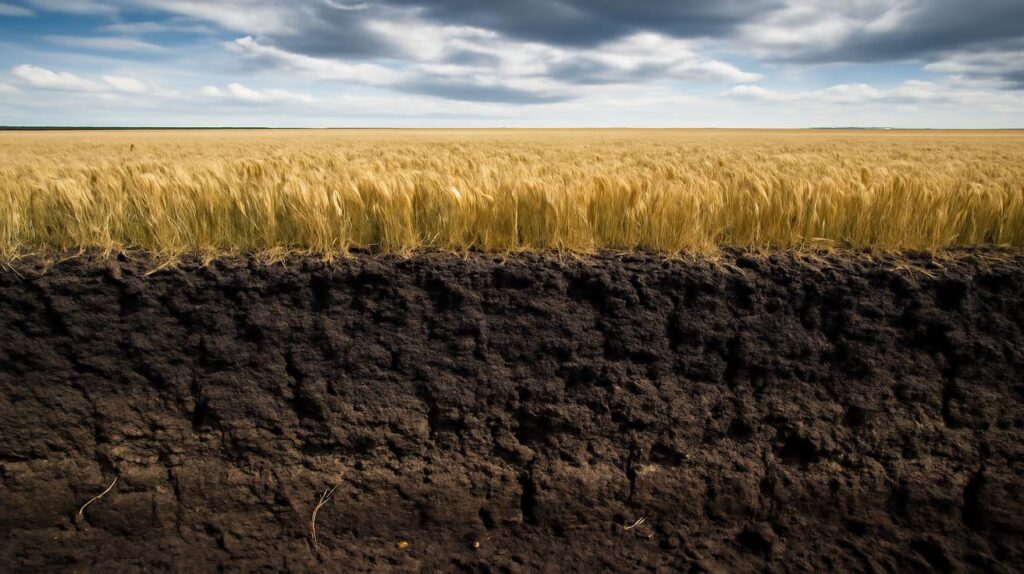
Push your fingers into it and it doesn’t clump like wet clay or scatter like dust. It breaks apart into moist, velvety crumbs, full of microscopic life and decaying plant matter. If you squeezed it, you’d feel the resilience, the way it holds together but doesn’t resist. This is soil that breathes, soil that remembers every blade of grass, every root and stalk that ever grew here. Soil so fertile that, in some places, the dark layer reaches one meter deep—like standing at the edge of a living, breathing archive of grasslands and seasons gone by.
Long before politicians argued over borders, before satellites watched these plains from orbit, people walked this earth and took note of its power. Nomadic herders, early farmers, traveling scientists—they all noticed the same thing: plants here did not just grow; they thrived. Wheat bent low with heavy heads of grain. Sunflowers turned thick-necked toward the sun. Fields did not tire easily; they could give and give, season after season.
This was not just soil. This was destiny packed into a meter of black earth.
The Making of a Breadbasket
From Grass Sea to Grain Sea
To understand chernozem, you have to imagine what came before the plow. Picture a sea of grasses stretching from Eastern Europe through western Siberia. For thousands of years, tall grasses rose and fell with the wind, died back each autumn, and returned every spring. Their roots remained woven in the ground, forming an invisible forest beneath the surface—dense, fibrous, and full of life.
Every year, this underground forest died a little and lived a little, creating a slow rain of organic matter that sank into the soil. Microbes got to work, breaking down roots, stems, and leaves, stitching carbon into the earth. Fires sometimes swept across the steppe, charring plants and adding ash and minerals to the mix. Winters froze the ground; summers baked it dry. And through all of it, the soil kept deepening, darkening, thickening—like a pot of stew simmering for millennia.
The result was chernozem: a soil rich in humus, the dark organic material that gives it its almost black color. Up to 15% organic matter in some places, compared to just a few percent in typical agricultural soils. It became a reservoir of nutrients and moisture, a bank of fertility that plants could draw from even in harsh conditions. Beneath your boots, where you might see “just dirt,” lies one of the silent engines of human civilization.
Turning Steppe into Strategy
When the first plows bit into these plains, an era began that would eventually redraw global maps. Ukraine, southern Russia, and northern Kazakhstan—together part of the vast Eurasian steppe—turned into an agricultural powerhouse. Wheat fields replaced wild grasslands; villages grew into grain hubs; train lines and river routes formed the veins of a new economic body.
By the late 19th and early 20th centuries, this region was recognized as one of the world’s great breadbaskets. Grain from these black fields flowed toward Europe, the Middle East, and beyond. Today, Ukraine, Russia, and Kazakhstan consistently rank among the top global exporters of wheat and other grains, feeding hundreds of millions of people far from the source of this soil.
What began as a quiet miracle of nature—grass, time, microbes, and patience—became a strategic asset visible from boardrooms and war rooms alike. Whoever controlled the black earth held influence over bread prices, food security, and, by extension, political stability in distant countries. In the most literal sense, global power began to depend on what happened in the top meter of soil in these vast plains.
What Makes Black Earth So Special?
The Science Under Your Boots
At first touch, chernozem feels luxurious, like a fabric that costs more than you should spend. But its value is not just in how it looks or feels; it lies in how it works. Beneath that dark color is a particular blend of structure, chemistry, and biology that seems fine-tuned for growing food.
Here’s what makes chernozem so extraordinary:
- High organic matter: Humus acts like a sponge, holding water and nutrients that plants can gradually access.
- Rich nutrient content: Nitrogen, phosphorus, calcium, and other essential elements are abundant and relatively available to crops.
- Excellent structure: The crumbly, granular texture lets roots penetrate easily, allows air to move, and prevents water from pooling or running off too quickly.
- Deep profile: With dark layers sometimes reaching a meter or more, roots have room to explore and resilience against drought.
All this matters more than it might seem. In many parts of the world, farmers fight against their soil: too sandy and nutrients just wash away; too clay-rich and roots struggle for air and space; too shallow and crops suffer as soon as the rain stops. But in chernozem, the soil behaves like a partner rather than an obstacle. It forgives imperfect years, cushions against bad weather, and responds generously to careful management.
To get a sense of just how dramatic the advantage is, consider a simple comparison:
| Soil Feature | Typical Agricultural Soil | Chernozem “Black Earth” |
|---|---|---|
| Organic Matter Content | 1–4% | Up to ~15% |
| Color | Light brown to reddish | Dark brown to almost black |
| Typical Depth of Fertile Layer | 20–30 cm | Up to ~100 cm |
| Water-Holding Capacity | Moderate | High, with slow, steady release |
| Natural Fertility | Often needs heavy fertilization | High, even with moderate inputs |
In a world of thin and tired soils, chernozem is like an old-growth forest floor—dense, dark, and alive with potential.
Soil as Silent Power
We rarely talk about soil at the same table where global power is discussed, but in the case of chernozem, we should. Control of these black earth regions has been contested for centuries, not only for ideology, borders, or identity, but for what lies beneath the surface.
Grain is not just food; it is leverage. It determines whether bread prices stay steady or spike in far-off cities. It shapes whether importing countries feel secure or anxious. When drought, conflict, or trade tensions disrupt exports from Ukraine, Russia, or Kazakhstan, the effects ripple through markets in North Africa, the Middle East, and Asia. Shelves in bakeries, the cost of noodles, the price of animal feed—all tilt subtly as the balance shifts.
All of that power is rooted—literally—in the black horizon of chernozem. It’s easy to think of strategic resources as things that glint: oil, gas, rare metals. But here, strategy looks matte and crumbly and dark. It stains boots, not balance sheets, yet it underwrites entire economies.
Lives Written in Soil
Farmers of the Black Earth
To read about chernozem in a textbook is one thing. To walk with a farmer across a black field is another. On a summer afternoon in central Kazakhstan, a man in a faded cap kneels by a row of wheat, presses his fingers into the soil, and breaks it apart with practiced ease.
“This,” he says, nodding at the earth, “is why we stay.” His grandparents survived on this land; his children play in the stubble after harvest. The soil is both heritage and insurance—something that, if treated well, might outlast them all.
Across the border in southern Russia, a woman managing a mid-sized farm checks moisture levels, runs her palm along the surface, and can tell if the last rain really sank in. She knows where the soil is fattest, where the humus is deepest, where the land still remembers the wild steppe it used to be. Her life is a negotiation with weather, markets, and machinery, but beneath it all is a steady faith in the black earth’s ability to recover, to forgive.
In Ukraine, where fields of wheat and sunflowers have become symbols of both abundance and vulnerability, the soil holds complicated meanings. It’s a source of pride and identity, but also a reminder of fragility. When conflict threatens transport routes or damages land, it’s not just an economic loss; it’s an assault on something deeply rooted in culture and memory—a shared belief that this country is, and should remain, one of the world’s great breadbaskets.
Memory of Grass, Memory of Grain
Walk this land in quiet seasons—late autumn, perhaps, when the fields are brown and bare—and the noise of harvest has faded. If you stand still long enough, you might almost hear it: the whisper of grasses that once swayed here long before tractors or trains. The soil remembers them. It holds their carbon, their minerals, their stories, stacked layer upon layer.
Now, it is wheat and barley that write the latest chapter. Year after year, plows and drills and combines trace new lines across the same stage. From above, fields look like patchwork; from ground level, they feel like an unbroken expanse. But under the surface, the same processes that built the black earth continue, faster now, more strained: roots grow and die, microbes feast, carbon arrives and leaves, sometimes too quickly.
Soil is not a fossil; it is an ongoing conversation between life, death, and time. Chernozem may feel ancient and inexhaustible, but it is as mortal as any ecosystem once pushed too far.
The Fragility of Black Gold
Can Something This Rich Be Exhausted?
It’s tempting to believe that a meter of black earth is more than enough—too deep to deplete, too generous to fail. But history offers warnings. Even the best soil can be exhausted if overworked, eroded, or stripped of organic matter faster than it is replaced.
Intensive monoculture agriculture—growing the same crops over and over, plowing deeply every season, relying heavily on synthetic fertilizers—can turn even chernozem from luxury to liability. Strip away the protective cover of plants, and wind will lift the topsoil. Leave it bare between rains, and water will carve gullies where rich earth washes away. Push for maximum short-term yields, and the soil’s intricate web of life begins to fray.
For a long time, the sheer depth of chernozem made it seem invincible. But farmers and soil scientists now understand that this wealth, built over thousands of years, can be degraded in a mere few decades. Organic matter can burn away; compaction can suffocate roots; erosion can bite into those once-proud black profiles, centimeter by centimeter.
Guardians of a Global Asset
In response, a quiet revolution has been unfolding across many black earth farms. Some farmers are reducing or abandoning deep plowing, turning instead to no-till or minimum-till methods that keep soil structure intact. Others are planting cover crops—rye, clover, vetch—to shield the earth in winter, feed the microbes, and add back organic matter.
Crop rotations, once seen as old-fashioned, are earning renewed respect. Alternating cereals with legumes and oilseeds helps balance nutrient demands, interrupt pest cycles, and maintain the soil’s diversity. Adding manure or compost, managing residues, carefully timing traffic on wet fields—these choices, field by field, are acts of guardianship over something that the world depends on but rarely sees.
From a distance, you might only notice that the fields still turn green in spring and gold in summer. But up close, in the details of how those fields are managed, lies the answer to a critical question: will the black earth continue to feed the world’s bread ovens, or will it slowly fade to a pale imitation of its former self?
Why Chernozem Matters to You
You might never stand on a Ukrainian field at dawn or run your fingers through a meter of chernozem in Kazakhstan. You might live in a city high-rise, far from any plow or grain silo. But the black gold of agriculture threads into your life more intimately than you might think.
It’s in the flour that becomes bread on your table, in the noodles simmering in your soup, in the animal feed that raises the dairy and meat you buy at the market. It’s in the stability of food prices, in the calm or anxiety that governments feel when they negotiate trade deals or weather sudden shortages.
Every time you slice a loaf, somewhere in the background is a farmer looking at the sky over a black field, hoping for just enough rain but not too much, for open borders and working ports, for peace instead of disruption. Somewhere beneath that farmer’s boots is soil that took thousands of years to become what it is—and could, if we’re careless, lose its strength in a fraction of that time.
Chernozem is a reminder that some of the world’s most strategic resources do not shine or roar. They do not tower or glitter. They lie quietly underfoot, turning sunlight, rain, and human effort into grains that bind societies together. To know this black earth is to recognize that our future is not only written in the sky, or in data, or in policy—but also, very literally, in the soil.
FAQ
What exactly is chernozem?
Chernozem is a type of very fertile soil rich in organic matter, typically dark brown to black, with a deep layer (often up to 1 meter) of humus. It forms mainly under grassland ecosystems and is especially common in Ukraine, Russia, and Kazakhstan.
Why is chernozem called “black gold of agriculture”?
It’s called “black gold” because its dark color signals high fertility and organic matter, making it extremely valuable for farming. Like oil or minerals, it is a strategic resource, but instead of fueling machines, it fuels food production.
How did chernozem form?
Chernozem formed over thousands of years under natural grasslands. Repeated cycles of grass growth and decay, root turnover, microbial activity, and occasional fires slowly built up thick layers of humus-rich soil.
Which countries benefit most from chernozem?
Ukraine, Russia, and Kazakhstan have some of the world’s largest and most famous chernozem regions. These soils help make them major global exporters of wheat and other grains, turning the region into a vital breadbasket.
Can chernozem be destroyed or degraded?
Yes. Intensive plowing, poor crop rotations, erosion, and loss of organic matter can degrade even the best chernozem. While it forms very slowly, it can be damaged quickly, which is why conservation practices and careful management are crucial.
How does chernozem affect global food security?
Because it underpins large-scale grain production, chernozem directly influences global grain supply and prices. Disruptions in production or export from these regions can affect food availability and costs in many importing countries.
Can we create chernozem elsewhere?
We can improve soils and increase organic matter through good management, but true chernozem—formed naturally over millennia under specific climate and vegetation conditions—cannot be quickly replicated. It’s a slow gift of time and ecology, not an instant product.