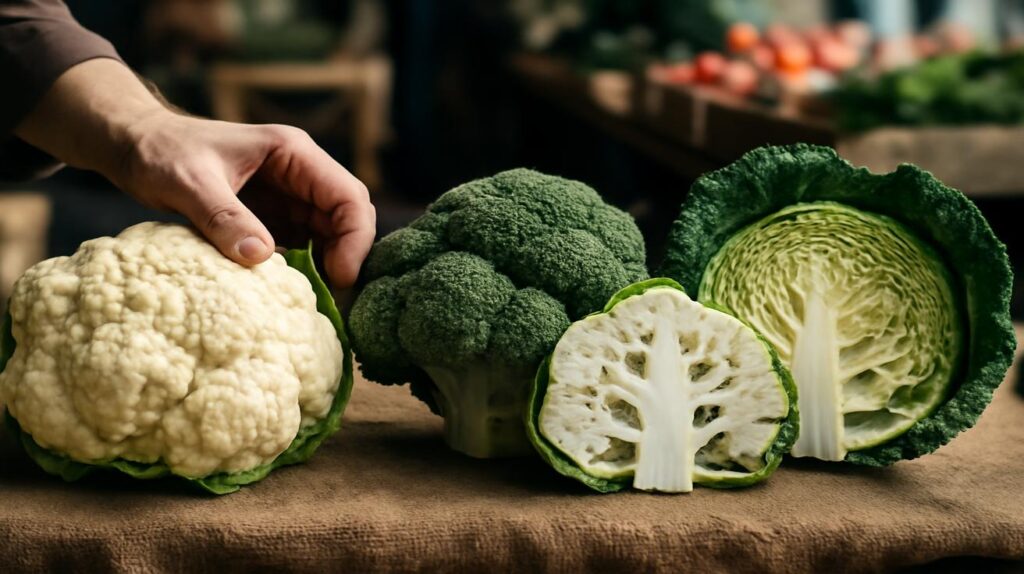
The first time you learn that cauliflower, broccoli, cabbage, kale, Brussels sprouts and even kohlrabi are all the same plant, it almost feels like someone has slipped a magic trick into your dinner plate. You pause, fork in mid-air, staring back and forth between a snowy-white cauliflower floret and a crinkled cabbage leaf, thinking: No way. These can’t be the same thing. But they are. All of them are just different versions—different outfits, really—of one quietly extraordinary species: Brassica oleracea, the wild mustard of old seacoasts and wind-bent cliffs.
The Wild Ancestor on the Windy Cliffs
Imagine standing on a rocky coastline somewhere along the Atlantic, where Europe’s shore juts into cold, restless water. Salt hangs in the air. Gulls cut across the wind. On the cracks between stones and at the feet of chalky cliffs grows an unassuming, sturdy plant—thick-stemmed, waxy-leaved, a dull green that reflects light just enough to seem both hardy and a little luminous. This is wild cabbage, the ancient ancestor of the vegetables that now crowd your produce aisle.
Centuries ago, people living along these coasts noticed this plant. It wasn’t romantic. It didn’t glow or shimmer or smell of sweetness. It just… survived. Wild cabbage thrived where other plants struggled—on poor, salty soil, lashed by wind, baked by sun. That toughness got the attention of hungry humans long before supermarkets, before recipes, before even written language in many places. They tasted the leaves, probably boiling them for a long time to tame the bitterness, and realized: this rugged little plant was something worth keeping around.
From there, the story becomes both simple and astonishing. People started saving seeds from plants with slightly thicker leaves, or bigger buds, or plumper stems. Generation after generation, they nudged this wild plant in many different directions, almost like a sculptor turning one block of stone into several wildly different statues. At some point along that slow, deliberate path, cauliflower, broccoli, and cabbage began to take shape—three dramatically different forms, still genetically close enough to be one plant, but visually far enough apart that most of us never suspect their shared origin.
One Plant, Many Bodies: How Brassica Got So Weird
Walk into a farmers’ market and take a slow look at a spread of Brassicas. A tight green cabbage, round and heavy as a stone. A broccoli head, like a miniature forest canopy of buds. A cauliflower, pale and cloud-like, nested in soft green leaves. Kale bunches, all ruffled edges and dramatic frills. Brussels sprouts, clustered like small, determined planets on a central stalk.
All of these have the same scientific first and last name: Brassica oleracea. What changes is the “middle name,” what botanists call the cultivar group: Capitata for cabbage, Botrytis for cauliflower, Italica for broccoli, and so on. That’s how closely related they are—different endings on the same family name.
The reason they look so different is almost like a lesson in how far you can push the body of a plant. Humans selected for extreme versions of normal plant parts:
- Cabbage is a plant that became all about leaves—thickened, layered, wrapped tightly into a compact head that stores easily.
- Broccoli focused on its flower buds—harvesting them just before they open, so you get that dense, bumpy crown of tiny unopened blossoms.
- Cauliflower took the same idea but went even further, forming a dense, curd-like mass of arrested flower tissue that never quite becomes a typical flower head.
In a sense, every one of these vegetables is an exaggeration: a leaf exaggerated, a bud exaggerated, a stem exaggerated. Over thousands of years, farmers and gardeners kept choosing the quirkiest versions and rewarding them with survival. The result is a kind of botanical kaleidoscope, all turning around one single species.
Cauliflower, Broccoli, Cabbage: A Side-by-Side Look
However surprising it is, the shared origin of these vegetables becomes easier to grasp when you set them side by side and trace them back to their plant parts and uses. Here’s a simple way to see how they align:
| Vegetable | Plant Part We Eat | Cultivar Group | Typical Texture & Use |
|---|---|---|---|
| Cabbage | Leaves (tight, layered head) | Capitata | Crunchy when raw; great for slaws, salads, fermentation (sauerkraut, kimchi) |
| Broccoli | Immature flower buds + tender stem | Italica | Firm, slightly crunchy; ideal for steaming, stir-frying, roasting |
| Cauliflower | Dense, arrested flower structure (“curd”) | Botrytis | Tender, crumbly; roasts beautifully, blends into soups, mashes, “rice” |
Seen this way, the trio begins to feel less like strangers and more like siblings who took different life paths. Same family, same bones—different personalities.
Inside the Hidden Family Drama
Behind every form of Brassica oleracea is an old human decision. Someone, somewhere in history, looked at a slightly unusual plant and thought, That one. That cabbage with the tighter head. That broccoli with the thicker stem. That cauliflower with the strange, pale mass at its center.
Over time, their quiet preferences turned into the vegetables that anchor cuisines around the world. In northern Europe, cabbage became essential winter food—storable, fermentable, reliable as the hearth itself. In the Mediterranean, broccoli flourished in mild winters and cool springs. Cauliflower, with its delicate, almost creamy interior texture, slipped easily into sauces, pickles, and braises from Italy to India.
There’s a touch of drama in how these vegetables grew into different cultural roles. Cabbage was the workhorse: feed-the-family, cheap, filling, common. Broccoli had a flashier arc—once scorned by picky eaters, later reborn as a health food darling, dark green and antioxidant-rich. Cauliflower had an even stranger journey: long seen as a plain, almost bland side dish, suddenly vaulted into stardom in recent years, morphing into pizza crusts, “wings,” rice, and mash, all because of its mild flavor and adaptable texture.
And the whole time, genetically, they stayed tethered to that salt-kissed ancestor clinging to the cliffs.
Following the Scent: How They Taste and Why
Cook a mix of cabbage, cauliflower and broccoli in the same kitchen, and an unmistakable aroma blooms in the air. It’s earthy, sometimes sulfurous, almost peppery. Some people adore it; others find it overpowering. That shared scent is another clue to their deep connection.
These vegetables are rich in compounds called glucosinolates. When you chop, chew or cook them, those compounds break apart and release molecules that give mustard, horseradish, wasabi—and yes, cabbage and broccoli—their sharpness. Wild cabbage likely evolved these chemicals as a defense mechanism, discouraging insects and animals from feasting too freely. Humans, however, learned to embrace that tangy, slightly bitter edge.
If you pay attention while you eat, you’ll notice the family resemblance:
- Raw cabbage: crisp, juicy, slightly sweet but with a peppery spine that tingles on your tongue.
- Broccoli: greener, grassier, the buds textured like tiny beads, with that signature bitterness softening when steamed or roasted.
- Cauliflower: gentler and milder, its flavor almost nutty when caramelized in the oven, soaking up spices like a sponge.
The differences are in the details, but the base note, that complex Brassica flavor, is shared. It’s the taste of an evolutionary bargain between survival and appeal, sharpened and softened over thousands of dinners.
In the Garden: Seeing the Connection with Your Own Eyes
If you’ve only met these vegetables in grocery-store form, neatly trimmed and stacked, it’s easy to miss their shared blueprint. The best way to truly understand their kinship is to see them growing.
In a cool-season garden, plant cabbage, broccoli and cauliflower side by side. Watch them emerge. First, there’s the seedling stage: small, bluish-green leaves, faintly waxy, almost identical between them. As they grow, their shared ancestry becomes obvious. They all have thick, sturdy stems. Their leaves have that same sea-green hue, often with a slight purple blush near the veins. Only later, as they mature, do their destinies diverge:
- The cabbage gradually tucks its leaves inward, layering them tighter and tighter until it forms a dense ball at the plant’s center.
- The broccoli pushes upward, forming a dome of numerous tiny buds, each one the potential for a yellow flower.
- The cauliflower folds in on itself in a stranger way, forming that creamy-white, brain-like curd, especially when inner leaves naturally shelter it from the sun.
Insects seem to know they are all related too. The same caterpillars, glistening green and insatiable, happily eat their way across cabbage, cauliflower, broccoli and kale without a hint of prejudice. In a sense, a Brassica bed in a garden is a living family reunion: different personalities, same vulnerabilities, same strengths.
On the Plate: One Species, Infinite Dinners
Once you understand that these vegetables come from a single plant, something subtle shifts in the kitchen. You start to cook them not as unrelated items but as variations on a theme, a palette of textures and flavors drawn from one ancestral source.
Think of a simple roasting pan on a cool evening. You toss together broccoli florets, cauliflower chunks, and wedges of cabbage with olive oil, salt and cracked pepper. As they roast, the edges of the cabbage crisp and char, turning sweet and faintly smoky. The broccoli darkens at the tips, gaining that irresistible chew. The cauliflower browns in patches, transforming into something both tender and toothsome. They’re distinct, yes, but there’s harmony on that tray, like three voices singing in the same key.
Across different cultures, cooks have intuitively treated them as members of the same clan:
- In Eastern Europe, cabbage stews and braises nestle next to broccoli soups and cauliflower gratins, different dishes, same comfort.
- In parts of India, cauliflower and cabbage both show up in spiced, turmeric-gold curries, often cooked until soft enough to soak in flavor yet firm enough to hold their shape.
- In East Asia, quickly stir-fried cabbage and broccoli share the same sizzling woks, kissed by garlic, ginger and soy.
From a nutritional standpoint, they share family traits as well: rich in vitamin C, vitamin K, fiber, and a constellation of plant compounds now celebrated for their potential roles in supporting health. You start to see them less as separate star players and more as one reliable ensemble, offering you many forms of essentially the same deeply resilient plant.
Seeing the Grocery Aisle with New Eyes
On your next grocery run, pause for a moment in front of the vegetable section. Let your eyes travel from the pale dome of a cauliflower to the emerald crown of a broccoli, to the layered globe of a cabbage. Imagine the salt-sprayed cliffs where their ancestor clung to life. Imagine the hands—countless, nameless—who chose seed after seed after seed, drawn by thickness or tenderness or tightness of leaf. Imagine that slow, quiet act of shaping.
Cauliflower, broccoli and cabbage are not just ingredients; they are the record of human curiosity written into plant flesh. The same species, split into different destinies by the desires of the people who depended on them. Once you know that, your relationship with them changes just a little. You might give that cabbage an extra moment of respect as you halve it, admiring the spiral of its leaves. You might glance at a floret of cauliflower and hear echoes of the tiny, never-fully-realized flowers it could have become. You might savor broccoli’s small forest of buds, knowing they are a band of halted blooms, frozen in their moment of almost.
Many people don’t realize that cauliflower, broccoli and cabbage are essentially one plant wearing different costumes. But once you do realize it, you start to notice the family resemblance everywhere: in flavor, in form, in the way they grow, in the way they cook. The produce aisle stops being a random collection of things and starts to look more like a living family tree, full of cousins and siblings, all whispering back to a single wild ancestor holding fast to stone above the sea.
Frequently Asked Questions
Are cauliflower, broccoli and cabbage really the same species?
Yes. Cauliflower, broccoli and cabbage are all cultivated varieties of the same species, Brassica oleracea. They have been selectively bred over centuries to emphasize different plant parts—leaves for cabbage, flower buds for broccoli, and a dense arrested flower structure for cauliflower.
Why do they look so different if they are the same plant?
They look different because humans selected for extreme versions of normal traits. By repeatedly choosing plants with tighter leaves, larger buds or denser flower structures, farmers gradually created distinct forms. Over generations, these differences became pronounced enough to give us the vegetables we recognize today.
Do they have similar nutritional benefits?
They share many nutritional qualities. All three are rich in vitamin C, vitamin K and dietary fiber. They also contain similar sulfur-based compounds called glucosinolates, which are being studied for potential health benefits. There are differences—broccoli, for instance, tends to be higher in some antioxidants—but overall they’re all nutrient-dense choices.
Can they cross-pollinate in the garden?
Because they are the same species, they can cross-pollinate if they flower at the same time and are growing near each other. This usually doesn’t affect the vegetables you’re currently eating, but it can influence the seeds you save for the next season, potentially producing unpredictable hybrids.
Do they all come from wild cabbage?
Yes. The common ancestor of cauliflower, broccoli and cabbage is wild cabbage, a tough coastal plant native to parts of Europe. Over thousands of years, people domesticated and diversified it into the many forms of Brassica oleracea we know today, including these three familiar vegetables.