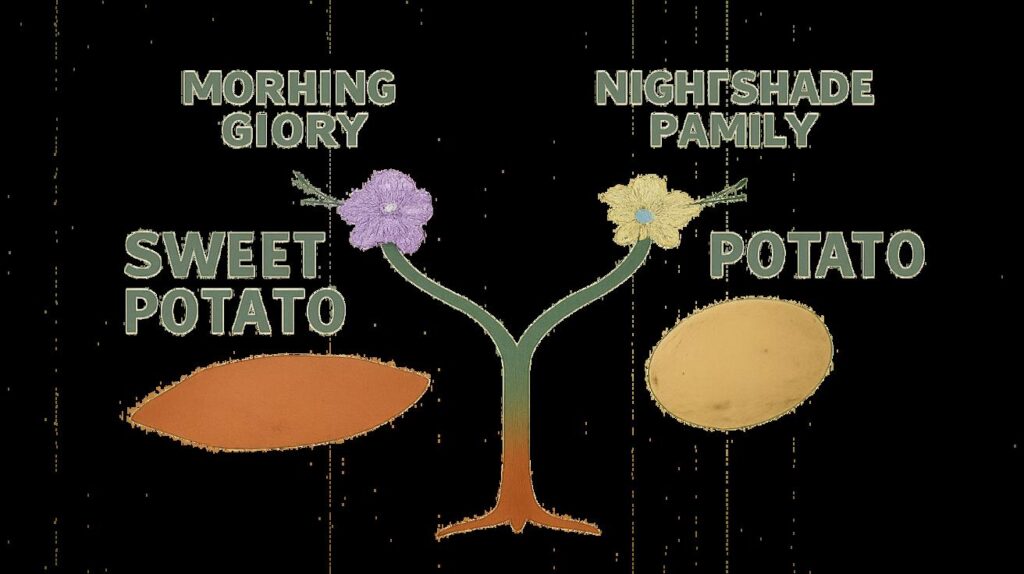
The first time you slice into a sweet potato and a regular potato side by side, it’s hard not to feel a little wonder. One bleeds a pale, starchy white; the other glows a saturated orange, like a sunset captured in root form. They roast the same, more or less. They mash the same. They nestle into stews and soups without complaint. In the grocery store, they sit almost shoulder to shoulder, as if they are siblings – or at least cousins who see each other every holiday season.
Yet if you follow their stories back through the soil and across the centuries, you find something quietly astonishing: sweet potatoes and regular potatoes are barely related at all. In the eyes of a botanist, they’re about as distant as a maple tree and a tomato plant. Our kitchens have made them neighbors, but science insists they are strangers.
The Grocery Aisle Illusion
Walk into any supermarket and you can feel the illusion settling in. Under the fluorescent lights, baskets of dusty brown tubers and smooth, orange-skinned roots are piled into the same section: “Potatoes.” Handwritten signs might distinguish “russet” from “sweet,” but the message is clear – these are variations of a single thing. A potato is a potato is a potato.
You reach for them with the same motions: test for firmness, avoid sprouting eyes, think ahead to dinner. A bag of russets for baked potatoes. A couple of sweet potatoes for that roasted side dish you saw in a magazine. You don’t question the relationship any more than you would question whether an apple and a pear are fruit.
But step out of the grocery store mind-set and into the world of plant science, and the illusion cracks. On the evolutionary family tree, the regular potato is perched on one branch with tomatoes, eggplants, and peppers. The sweet potato, however, has taken a different path altogether, ending up with morning glories – yes, the delicate blue and purple flowers that climb fences and garden trellises. If you’ve ever seen a sweet potato vine blossom, you may have caught a subtle clue: those trumpet-shaped flowers look uncannily like tiny, earthy-colored morning glories.
So why do these two plants, born in different botanical families, converge so neatly on our plates? Why do they both thicken into underground storage organs that look, cook, and comfort us in such similar ways? To answer that, we have to leave the aisles and walk into fields, then back through time.
The Secret Lives of Roots and Tubers
Imagine a potato plant in the high Andes, where the nights run cold and the growing season is a gamble. Above ground, the stems and leaves flirt with frost, wind, and insects. Below ground, something else is happening: a quiet, strategic hoarding of energy.
Regular potatoes form what botanists call tubers – swollen ends of underground stems. If you hold a potato in your hand, those dimples you see, the “eyes,” are actually buds on a modified stem. Given soil and time, each eye can sprout into a new plant. The tuber is both a pantry and a starter kit.
Sweet potatoes play a slightly different game. They’re not stem tubers but storage roots – thickened parts of the root system. Unlike potatoes, they don’t have eyes. You can’t plant a chunk of random sweet potato and expect it to sprout from its flesh; farmers instead start new plants from “slips,” which are rooted shoots cut from a mature sweet potato vine.
From the plant’s point of view, both strategies are strokes of evolutionary brilliance. When drought, frost, or hungry animals threaten the visible parts, the real treasure is buried. Sugars and starches are locked away underground, waiting for better days or a new season. Long before humans arrived with digging sticks, these plants were playing the same careful game: store energy, survive hardship, try again.
Scientists have a name for this kind of coincidence in evolution: convergent evolution. Two unrelated organisms, facing similar problems, stumble on similar solutions. Bats and birds both fly, but their wings evolved independently. Cacti in the Americas and euphorbias in Africa both became spiky water-hoarders, though their lineages are separate. Potatoes and sweet potatoes, standing in far-flung corners of the plant family tree, both evolved fat, edible underground organs – one through stems, the other through roots.
Convergent Evolution on Your Dinner Plate
The real magic of evolution isn’t always in the grand spectacles – the dinosaurs and the mammoths – but in these quieter, parallel inventions. When you lay a baked potato and a baked sweet potato side by side, you’re seeing millions of years of separate plant history softly rhyme. Different families, same idea: stash energy below ground in a nutrient-dense, long-lasting package that can outwait a bad season.
We just happened to arrive and notice that those packages taste really, really good.
When DNA Ruins a Good Assumption
For centuries, humans grouped plants the way we group most things at first glance: by what they look like, how they taste, how we use them. Regular potatoes and sweet potatoes were both cultivated roots, both filling, both cheap, both endlessly useful. So we bundled them together in our minds and our language. In many cultures, the same word stands in for both, with context doing the heavy lifting.
Then, in the last century or so, science changed the game. Microscopes, genetics, and molecular biology gave botanists tools that could peer beneath the surface. The question was no longer “Do these plants look similar?” but “How are their genes arranged? How many chromosomes do they have? What does their DNA say about their ancestors?”
In those deeper layers, the differences sharpened. Regular potatoes belong to the genus Solanum, in the nightshade family, Solanaceae. That clan includes tomatoes, peppers, eggplants, and a number of plants that harbor toxic alkaloids. Sweet potatoes, on the other hand, are in the genus Ipomoea, in the bindweed or morning glory family, Convolvulaceae. If you lined up their family trees, you’d have to scroll a long way before their branches even approached one another.
It’s not just paperwork-level difference, either. Their flower structures, pollen, leaf patterns, and internal chemistry bear the signatures of their respective families. If you’re trained to see it, a sweet potato flower tells an unmistakable morning glory story; a potato flower whispers of nightshades and their often-secret poisons.
The Failed Hybrid Experiment That Told Us Everything
When the language of genes entered the conversation, a natural question arose: if potatoes and sweet potatoes are truly related, could they cross-breed? Could we, at least in theory, create some strange middle child – a hybrid that’s part nightshade, part morning glory, part tuber, part storage root?
Plant breeders and scientists tried, of course. The idea was too tantalizing to ignore. But the biology refused to cooperate. Their chromosome counts and structures don’t line up in any workable way. Their reproductive systems politely decline the invitation. Crosses fail, seeds don’t form, or if they do, they don’t develop properly. Evolution’s long diverging roads cannot simply be stitched back together in a lab.
In a way, those failed experiments were as informative as any success. They confirmed what the DNA was already hinting: however similar they seem on our plates, potatoes and sweet potatoes are products of very different evolutionary journeys.
Two Origins, Two Civilizations, One Confusing Name
Now imagine the world a few thousand years ago, before the age of ships and global markets, before the word “potato” meant anything to anyone. In the high Andean valleys of South America, Indigenous farmers were selecting and saving the best underground tubers from wild nightshade relatives, slowly sculpting the modern potato. Farther north and west, in the tropical Americas – likely in parts of modern-day Central America or northern South America – other communities were doing something equally remarkable with a vining plant whose roots swelled sweet and dense.
These stories unfolded in parallel, with no need to link them. Each plant evolved with its people. The potato, cold-hardy and flexible, became a mountain staple. The sweet potato tied itself to warmer conditions, thriving in more tropical or subtropical climates. Cultures wove them into myths, rituals, and everyday meals. Neither needed the other to be complete.
The confusion began when Europeans set sail and started naming things.
How a Word Traveled Faster Than the Science
When Spanish explorers encountered sweet potatoes in the Caribbean and Central America, they met people who called the plant batata. That word – filtered through Spanish ears and tongues – soon collided with another new discovery from South America: the papa, the regular potato. Over time, “batata” and “papa” tangled, eventually giving us the English “potato.”
In some languages, sweet potatoes carried the older “batata” root forward as “patata” or similar words; in others, regular potatoes took center stage. In English, “sweet potato” became the name for one, while “potato” alone usually meant the other. The linguistic blur made it easy to assume a closer kinship than the plants truly shared.
Even today, some of that confusion lingers in the produce aisle. In parts of North America, orange-skinned sweet potatoes are sometimes labeled as “yams,” even though true yams – from yet another plant family, the Dioscoreaceae – are different again. It’s as if our language can’t quite keep up with the botanical subtleties, so it collapses them into the same friendly bucket: things that grow underground, feed us, and feel at home next to butter and salt.
What Science Sees That Our Taste Buds Don’t
The kinship your tongue senses when it meets a forkful of mash has little to do with ancestry and everything to do with chemistry. Both potatoes and sweet potatoes are loaded with starch – long chains of glucose molecules packed away for a future the plant will never see, thanks to our appetites.
But look closer, and you’ll find important differences. Regular potatoes skew heavily toward starch and a relatively low sugar content, which is why they taste more neutral, more like a blank canvas for whatever you put on top. Sweet potatoes, true to their name, carry more natural sugars and often more fiber. Their bright orange flesh comes from beta-carotene, the same pigment that colors carrots, and a precursor to vitamin A in our diet.
The result is a kind of nutritional mirroring. Both are sources of carbohydrates and comfort, but sweet potatoes often bring more vitamins and antioxidants to the table, while regular potatoes, especially when eaten with the skin, offer a generous dose of potassium and vitamin C. Both can be hearty building blocks of a meal or guilty pleasures, depending on what we do with the oil, salt, and toppings.
To see their similarities and differences at a glance, it helps to let the numbers speak for a moment.
| Per 100 g (cooked, plain) | Regular Potato | Sweet Potato |
|---|---|---|
| Calories | ~87 | ~90 |
| Total Carbohydrates | ~20 g | ~21 g |
| Sugars | ~1 g | ~6 g |
| Fiber | ~1.8 g | ~3.3 g |
| Vitamin A | Trace | Very high |
| Vitamin C | Moderate | Moderate |
| Potassium | High | High |
On a plate, our senses blur these differences into a general category of “comforting carbs.” Our brains recognize the warmth, the softness, the way both pair so effortlessly with fat and salt. Science, however, insists that similar function does not equal shared origin. Two tools can do the same job and still come from different workshops.
Why This Weird Fact Actually Matters
It’s tempting to file all of this under “fun trivia to pull out at dinner” and move on. And you certainly can. But there’s a deeper significance to knowing that sweet potatoes and regular potatoes are distant relatives disguised as cousins.
For one thing, their different family trees mean different vulnerabilities and strengths. A disease that sweeps through nightshade crops, threatening potatoes and tomatoes, won’t necessarily touch sweet potatoes in the same way. Farmers and plant breeders can lean on this diversity as a form of resilience, planting multiple staple crops from different lineages so that one blight doesn’t wipe out an entire food system – a lesson the potato famine in 19th-century Ireland burned painfully into history.
There’s also a quiet shift in how we see the world when we understand that similarity is not the same as sameness. Our daily lives are full of little convergences: technologies, habits, and even ideas that look alike on the surface but come from completely different origins. The story of these two “potatoes” is a gentle reminder to look a little deeper, to ask what paths led to the familiar objects we handle every day.
And on a more intimate level, there’s something deeply human in recognizing that our categories are often conveniences, not truths. We call both of these plants “potato” because it’s tidy and useful, not because evolution decreed it. Science doesn’t ask us to stop using the word; it simply invites us to see the nuance underneath. The grocery aisle is not wrong, exactly – just incomplete.
The Next Time You Bake One
The next time you slide a tray of chopped sweet potatoes and regular potatoes into the oven, drizzle them with oil, scatter salt and pepper over the top, you might glance at them a little differently. On one side of the pan: a child of nightshades, cousin to the tomato, ancestor shaped by cold, thin air, and Andean farmers. On the other: a morning glory underground, transformed by tropical heat and human hands into edible roots that glow orange and sweet.
They will emerge from the oven as equals in your meal – crisped at the edges, tender within, ready to be dragged through sauces or eaten straight from the pan. You will taste warmth, sweetness, starch, a hint of earth, and maybe a little char. You probably won’t think about chromosomes or families or ancestors.
But somewhere in your mind might flicker the knowledge that you’re eating the product of two separate evolutionary experiments that, by chance, arrived at nearly the same culinary destination. Science doesn’t ruin the magic of that moment. It deepens it. The more we know about the stories behind the food we eat, the more extraordinary the ordinary plate becomes.
Frequently Asked Questions
Are sweet potatoes and regular potatoes from the same plant family?
No. Regular potatoes are in the nightshade family (Solanaceae), while sweet potatoes belong to the morning glory family (Convolvulaceae). They look similar because of convergent evolution, not close kinship.
Can sweet potatoes and regular potatoes cross-breed?
No. Their genetics, chromosome structures, and reproductive systems are too different. Attempts to hybridize them have failed, which supports the conclusion that they are only distantly related.
Which is healthier: sweet potatoes or regular potatoes?
It depends on what you’re looking for. Sweet potatoes tend to provide more fiber and a lot of vitamin A (from beta-carotene). Regular potatoes often have slightly fewer sugars and are rich in potassium and vitamin C. How you cook them matters as much as which one you choose.
Why are sweet potatoes sometimes called yams in stores?
In some regions, especially in North America, orange-fleshed sweet potatoes were historically marketed as “yams” to distinguish them from paler varieties. True yams are a completely different plant from another family (Dioscoreaceae), but the mislabeling stuck in everyday language.
Do sweet potatoes and regular potatoes grow the same way?
Not exactly. Regular potatoes form stem tubers with “eyes” that can sprout new plants. Sweet potatoes form storage roots, and new plants are typically started from slips (young shoots) rather than from chunks of the root itself.
Why do they both store so much starch underground?
It’s an evolutionary survival strategy. Both plants evolved to store energy below ground to survive bad seasons and regrow later. They arrived at similar storage strategies independently, a textbook case of convergent evolution.
Does knowing they’re barely related change how I should cook them?
Not really. Their botanical distance doesn’t affect their basic culinary uses. It simply gives you a richer story to tell while you roast, mash, or fry them – and perhaps a new appreciation for the hidden complexity of everyday food.