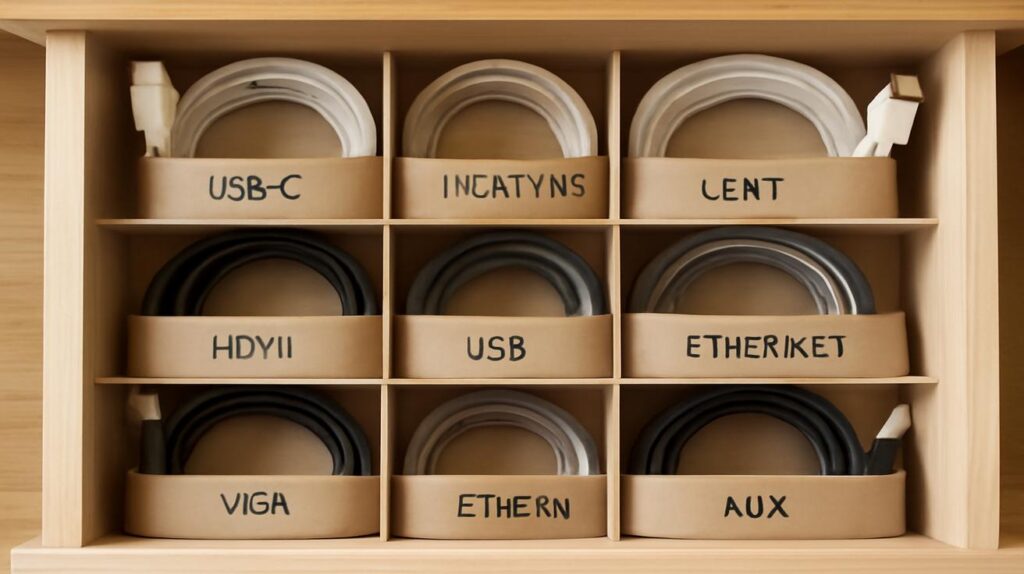
The first time I saw someone gently coil a cable the “right” way, it felt like watching a small act of magic. We were standing in a sunlit workshop that smelled faintly of sawdust and coffee, and an old extension cord lay tangled between us like a defeated snake. My instinct was to wrap it around my arm and elbow the way I’d done since childhood, creating that stiff, spring-loaded loop that never quite behaves. Instead, my friend shook his head, smiled, and began to turn the cable in his hands as if he were coaxing it into cooperation. The cord fell into soft, obedient circles on the floor, each loop lying flat, no twist, no tension. When he was done, he lifted the whole bundle with one hand and it stayed together, as calm as a resting cat.
How Cable Chaos Slowly Takes Over Your Life
Open almost any drawer in any modern home and you’ll find it: the cable nest. A layered, archeological tangle of old phone chargers, USB adapters, earbuds with one side dead, HDMI cords from long-gone TVs, and that one mysterious cable you’re afraid to throw away “just in case.” They cling to one another, knotting themselves into strange marriages—an Ethernet cable braided around a camera strap, a hair tie fused with a power adapter. You pull one cord and three more come with it, like seaweed dragged up from the bottom of a lake.
We live in an era of disappearing objects—music is in the cloud, books live in devices thinner than a magazine—but cables stubbornly remain. They are the last physical umbilical cords tying us to power, data, and the invisible rivers of electricity in our walls. And yet, most of us treat them as afterthoughts. We shove them into drawers, wind them in tight figure-eights around our palms, cinch them with aggressive rubber bands, or wrap them around the devices themselves until the plastic sheathing strains in protest.
This isn’t just about neatness. It’s about access. A tangled drawer is a tiny tax on your life, paid in minutes and micro-frustrations. You only notice it when you need something quickly: the laptop charger before a meeting, the phone cable as the battery blinks red, the printer cord when you promised yourself you’d finally print those forms. You know it’s in there somewhere. But finding it means confronting the nest, and the nest always resists.
The Quiet Damage of Storing Cables Wrong
Most cable problems don’t announce themselves with drama. They begin quietly. A subtle stiffness where the wire meets the plug. A faint crackling when you twist the connector. A charger that only works when you bend it “just so.” We blame planned obsolescence, cheap manufacturing, or the age of the device. Often, though, it’s the way we’ve been storing them.
When you coil a cable in fast, tight loops—especially the classic elbow wrap—you’re forcing it into a shape it doesn’t want to hold. Inside that harmless-looking plastic sleeve are tiny copper strands, arranged in careful patterns. Twist them the wrong way, over and over, and they start to fatigue. The bends become permanent; the conductors inside can break, weaken, or separate. That’s why some cables never quite lay flat again, always holding a kink like a bad memory.
Then there’s the bend at the connector. Wrapping a cable around a device and pulling it taut, like a belt around a suitcase, puts all the pressure at this weakest point. It’s the knee of the cable—the part that is asked to flex most often and yet is given the least support. You can see the scars: frayed insulation, exposed inner wires, that telltale whitening where the plastic has been stretched too far.
And if there’s a drawer involved, the damage multiplies. Cables twist around each other and snag. You tug them free, adding another sharp bend, another stress point. Over time, your cable collection becomes a kind of silent graveyard of minor abuses—a gallery of tiny, preventable failures.
The Simple Method Most People Never Learn
Somewhere along the way, a strange gap appeared between the people who work with cables for a living—sound engineers, filmmakers, stage techs—and the rest of us. In their world, there is one guiding principle for taming cables: the over-under method. It’s deceptively simple, oddly satisfying, and almost never taught outside of technical trades, despite its usefulness in everyday life.
Imagine your cable as a gentle river you’re inviting into loops, instead of a rope you’re forcing into submission. Instead of wrapping it in the same direction each time, you alternate: one loop that follows the cable’s natural curve (over), and one that subtly reverses it (under). Those opposing movements cancel out the twists that would otherwise build up along the length of the cord.
When you do it right, the cable doesn’t spiral or fight back. It falls into your hand like a soft rope, each loop lying on top of the last in a relaxed circle. When you go to use it again, you don’t have to shake it, argue with it, or do that frantic dance where you spin the connector trying to untwist the line. You simply toss it out, and it unfurls in a single, clean line.
The magic is not mystical. It’s geometry and patience. But to your future self—the one who just wants the cable to work and the day to move along—it feels miraculous.
Turning Cable Storage Into a Small Daily Ritual
There’s a tiny pleasure in doing one small thing properly, especially in a world moving so quickly that most interactions with objects feel rushed, transactional, or disposable. Storing cables well can be one of those quiet, grounding rituals, as unglamorous and deeply satisfying as sharpening a kitchen knife or oiling a well-used wooden cutting board.
Picture the end of a long day. Your phone charger hangs off the edge of the nightstand, halfway to the floor, already plotting its next tangle with the stack of books by your bed. Instead of letting it fall into chaos, you take ten seconds. Thumb and fingers, gentle rotation, a few calm loops. You secure it—not with a tight, suffocating knot—but with a soft reusable tie or a built-in Velcro strap. You place it in the small box, bowl, or dedicated spot where all charging cables live. There is, suddenly, one fewer place in your home where chaos reigns.
You can build this micro-ritual into the rhythms of your life:
- Every time you unplug a laptop charger, you give it thirty seconds of mindful coiling.
- When you pack a bag for travel, you lay each cable in a small pouch, coiled in the same, familiar way.
- After a work session that involved camera gear, headphones, or external drives, you end not by collapsing your laptop shut, but by gently restoring your cables to order.
None of this is about perfection. Drawers will still get messy. You will still occasionally shove a cable into a pocket because you’re rushing out the door. But a surprising amount of order grows from doing one thing thoughtfully, repeatedly. Over time, you begin to notice that the things you reach for most often are right where they should be, ready, untangled, and calm.
One Small System That Makes Every Cable Easy to Find
Good storage isn’t only about how you coil; it’s about where those coils go afterward. The method that keeps cables accessible is less about fancy containers and more about clear categories, consistent habits, and visual simplicity. Your goal is simple: when you need a cable, you should know exactly where to look, and you should be able to grab it without disturbing anything else.
Start by gathering every cable you own. Yes, all of them. Pull them from drawers, backpacks, boxes in the closet—the entire flock. As you spread them on a table, patterns begin to emerge: the identical white phone chargers, the tangle of black HDMI and power cables, the colorful earbuds, the ridiculous number of USB variations.
Now, you sort. Not just by function, but by how you actually live:
- Cables you use every single day (phone, laptop, headphones).
- Cables you use a few times a week (camera, tablet, external drives).
- Cables you only need occasionally (printer, old hard drives, special adapters).
- Cables you haven’t used in a year and can’t even identify.
The first two categories deserve prime real estate. These are the cables that should live within arm’s reach, in places you move through daily: a shallow tray on your desk, a slim box in your bag, a small organizer near the couch where you actually sit and charge things. Each one gets coiled with the same method, secured gently, and given its own visible niche.
The occasional-use cables can live further away: in a labeled basket in a closet, a shallow drawer, or a box on a shelf. They, too, get the same coiling ritual, so that when you need the old printer cable once a year, it emerges ready to work, not as a cryptic knot.
And those last cables—the unidentified, the obsolete, the duplicates beyond reason—are your chance to let go. There is a special lightness that comes from admitting, “I will never use this old proprietary charger again,” and recycling it responsibly.
To keep this newly tamed system from dissolving back into a nest, you don’t need discipline so much as design. Make it easier to put cables away properly than to toss them randomly. Use shallow containers so nothing is buried. Store coils vertically, like files, instead of in deep piles. Give yourself visual cues—a small label, a color-coded tie, or simply the pattern of where each type tends to live.
| Cable Type | How Often You Use It | Best Storage Spot | Suggested Tie/Label |
|---|---|---|---|
| Phone & laptop chargers | Daily | Desk tray, bedside bowl, everyday bag | Soft Velcro tie, color by device |
| Headphones & earbuds (wired) | Daily/Weekly | Small pouch, pocket in bag or jacket | Short elastic or built-in clip |
| HDMI, Ethernet, long USB cables | Weekly/Occasional | Labeled box or basket in closet | Reusable cable tie with label tab |
| Camera, printer, specialty adapters | Occasional | Gear-specific pouch or drawer | Paper tag or masking tape label |
| Old & unknown cables | Rare/Never | Separate “quarantine” box to review | Date label; consider recycling |
Learning the Feel of a Cooperative Cable
No diagram can quite capture the feeling of a well-coiled cable sliding through your fingers, but your hands can learn it faster than your eyes. Take a single, medium-length cable—something flexible, like a typical USB or audio cord—stand up, and let it hang from one hand so gravity straightens it out. There is already a story written into its shape; your job is to read, not rewrite.
With your free hand, pick up a short length near the connector and guide it into a loop about the size of a dinner plate. Don’t twist yet—just follow whatever curve the cable naturally offers. That’s your first “over.” For the next loop, instead of turning your wrist in the same direction, you subtly rotate your grip the opposite way as you bring the cable up, so the loop lies flat without adding tension. That’s your “under.”
Over, under. Over, under. A slow two-step. With each loop, you ask: does the cable look relaxed? Is there any part that seems to resist and kink? If so, let it spin gently between your fingers until it settles. What you’re doing is not far from working dough or handling rope on a small boat; it has that same mix of intention and responsiveness.
Once you’ve coiled the whole length, secure it with something that respects its softness. Avoid tight, thin rubber bands that pinch and dig in. Reach instead for a fabric tie, a strip of Velcro, or even a loose loop of twine. The bundle should feel like a loosely held stack of paper, not a strangled object fighting to escape.
When you toss this cable out again—onto the floor, across a desk—watch how it behaves. It should unfurl almost theatrically, a straight line from plug to plug with minimal twist. In this small experiment is the whole point: a few moments of attention now trade you many moments of ease later.
A House Where Cables Belong, Not Just Linger
There’s a small but significant shift that happens when cables stop being an annoyance and start becoming tools you actually trust. It changes your mornings, when your phone charger is exactly where you expect it, coiled neatly in the dish by the door. It changes your working rhythm, when connecting a second monitor or microphone is as simple as reaching into a specific box and pulling out a cable that doesn’t need to be untangled first. It even changes how you pack, when the small pouch of coiled cords in your bag feels less like an afterthought and more like a compact, well-tended kit.
You begin to notice that the places you’ve given clear homes—desk drawer, living room shelf, travel pouch—become tiny islands of reliability. Cables are no longer exiles wandering from room to room, appearing suddenly behind furniture or hiding under piles of paper. They belong somewhere, and because they belong, you find yourself putting them back with less effort than it once took to ignore them.
Most of all, you realize that the cost of this order was not high. It didn’t require elaborate organizers, expensive boxes, or a day-long purging ritual. It asked only for a different kind of touch: gentler, more aware, more willing to work with the nature of the object. The over-under coil, the designated spots, the soft ties—they’re all variations on the same theme: paying just enough attention to your tools that they pay you back in smoothness, in readiness, in time.
There will always be enough chaos in the world that you can’t control. Your cables don’t need to join it. A drawer that opens to neat, accessible coils is a small kind of quiet victory, a private reminder that not everything has to be tangled to be real. Sometimes, the most ordinary objects—plastic-sheathed copper and rubber—can teach you a slow, practical kind of care. You pick up a cable at the end of the day, feel its weight and softness, guide it into calm loops, and in that small gesture, the world becomes just a little easier to plug into.
FAQ
Why does the way I coil cables actually matter?
The way you coil cables affects both their lifespan and how easy they are to use. Tight, repetitive twists stress the internal wires and make cables kink, tangle, and eventually fail. A gentle alternating coil like the over-under method keeps the internal strands relaxed and prevents permanent twisting, so cables last longer and unfurl cleanly.
Do I really need a special method for short cables?
Yes, though it can be simpler. Short cables still benefit from being loosely coiled in their natural curve and secured with a soft tie. You may not need a full over-under for very short cords, but avoiding tight bends—especially near connectors—will still help them survive daily use.
What should I use to keep coiled cables together?
Reusable fabric or Velcro ties are ideal because they’re soft, adjustable, and gentle on the cable. You can also use small elastic bands covered in fabric, twist ties with a soft coating, or even strips of cloth. Avoid thin, tight rubber bands that dig into the insulation and leave permanent dents.
How many cables is “too many” to keep?
That depends on your devices, but a good rule is: if you haven’t used a specific cable in a year and can’t name what it belongs to, it’s a strong candidate for recycling. Keep a few backups of common types (like USB-C or Lightning), but you rarely need more than two or three spares of any one kind.
What’s the best way to store cables if I have very little space?
Use vertical storage and small categories. A slim box or pouch with coiled cables stored upright, like files, is often enough. Keep everyday cables in a shallow tray or small bowl where you normally use them, and move infrequent cables to a labeled pouch or box on a shelf. Making items visible and easy to reach matters more than having large storage areas.
Can I fix a cable that’s already kinked or twisted?
You can often improve it, though you can’t undo internal damage. Let the cable hang freely to release tension, then gently run it through your fingers to smooth out sharp bends. Recoil it using the over-under method a few times. This resets the “memory” of the outer jacket and can help the cable behave more nicely, even if it’s not perfect.
Is it okay to wrap cables around the device they belong to?
Only if you do it loosely and avoid tight bends at the connector. Wrapping a cable tightly around a power brick, laptop, or charger stack puts a lot of strain where the wire meets the plug. It’s better to coil the cable separately in relaxed loops, secure it with a tie, and either rest it next to the device or place both in a small pouch or tray.