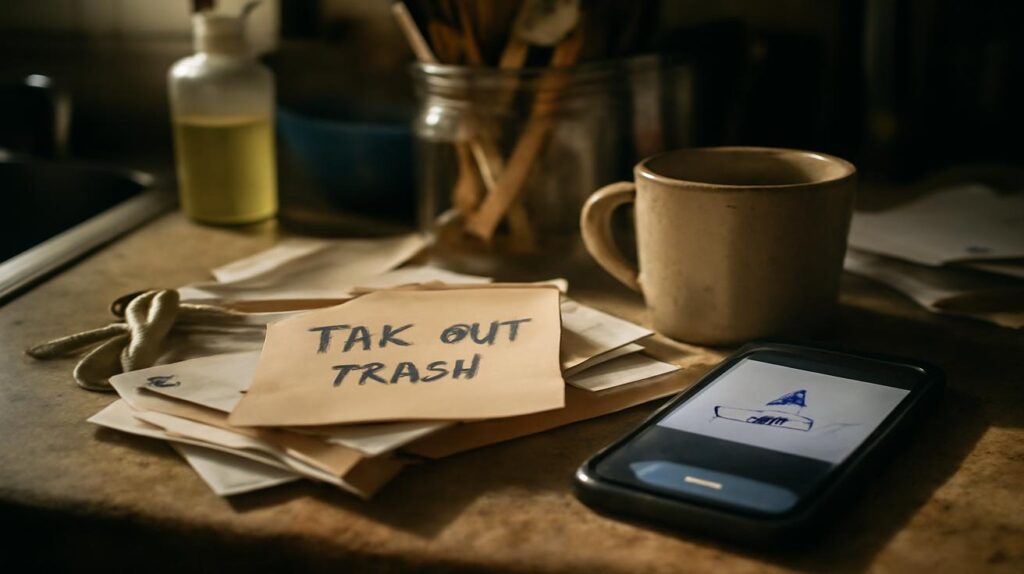
The note is still there, curling at the corners, stuck to the fridge door by a weak magnet shaped like a tomato. “Buy dish soap,” it says, in the hurried handwriting of a person who absolutely meant to remember. You walk past it three times on your way out the door. You remember to grab your keys, your bag, your phone. The dish soap? Not a chance. By the time you’re standing at the sink that evening, tilting the last reluctant drops out of the plastic bottle, you notice the red magnet again and feel that familiar flash of annoyance. How can something so small, so simple, be so easy to forget?
The Quiet Weight of the Things We Keep Forgetting
It’s strange how the smallest unfinished tasks can hum in the background of a day like a loose wire behind a wall. You might not see them, but you feel the faint buzz. The plant you keep meaning to water. The package you said you’d mail “tomorrow.” The text you never answered. None of them on their own would break you, but together they form a constant low-level static in the mind.
So you do what the world tells you to do: you turn to your phone. There’s an app for tasks, an app for habits, an app to remind you to drink water as if you were a distracted houseplant. You set reminders like digital breadcrumbs across the hours of your day, trusting the pings and banners to hold your life together.
But here’s the curious thing: the more reminders we set, the more we seem to forget. Reminders go off while you’re in the middle of something else, so you swipe them away. Notifications pile up like un-opened mail. Eventually, your brain stops believing that anything with a little red dot is truly urgent. The very tool you asked to help you remember is teaching you that it’s safe to ignore.
Meanwhile, outside the frame of your glowing screen, the world goes about its business with a very different system. A crow remembers where it hid a peanut. A squirrel recalls which yard held the best stash of acorns. A bee returns, unassisted by GPS, to the flowers she found yesterday. Nature has no apps, no push notifications, no color-coded calendar blocks. But it does have patterns. And patterns, as it turns out, are far more reliable than pings.
Why Your Brain Hates Loose Ends
Your brain is not a filing cabinet; it’s more like a living landscape. Paths are carved where you walk often, and they grow over where you don’t. When you keep forgetting small everyday tasks, it’s not because you’re broken or lazy—it’s because those tasks don’t have well-worn paths yet.
Cognitive scientists have a dry term for the stuff that falls through the cracks: prospective memory—the ability to remember to do something in the future. It’s what you rely on when you think, “I’ll take out the trash after dinner,” and then somehow walk straight past the overflowing bin on your way to bed. Prospective memory is tricky because it depends on two things happening at once: the right moment arriving, and your brain realizing, “Oh, this is the moment.” If nothing in your environment nudges that recognition, your intention drifts off, untethered.
So we outsource it. We stack digital reminders like stones, hoping they’ll build something sturdy. But outsourcing without understanding often just adds noise. A reminder that fires at 4:00 p.m. every Tuesday, regardless of what you’re doing, is like a neighbor knocking at random hours to ask if you’ve watered your plants yet. Sooner or later, you stop opening the door.
What the brain loves, instead, is context—environment, rhythm, smell, light, motion. Think of how easily you slip into brushing your teeth after you wash your face, or locking your door after you pick up your keys. Those are not reminders in the tech sense. They’re reminders in the ecological sense: one action leads you into the next like a well-worn forest trail.
Building a Landscape Instead of Downloading an App
Imagine for a moment that your day isn’t a calendar, but a small piece of landscape—something you could actually walk through. Morning sits beside coffee. The commute lives next to the crosswalk where the light always seems to take too long. Lunch hides behind that one email you dread opening. The question becomes: where, in that landscape, does the small task belong?
Take the chronically forgotten dish soap. You can set a reminder that shouts “BUY SOAP” at 5:15 p.m., but if you’re on a train, on a call, or lost in thought, the message is just another pebble thrown at your mental window. Instead, tether the task to something in your physical path. For example, as the empty bottle nears its end, drop it directly into your tote bag or backpack. Now, the next time you go out, the item itself is your reminder, its hollow rattle a tiny, plastic ghost at your side.
Or maybe you always forget to water the plant in the corner until its leaves begin to crisp at the edges. You could have an app nudge you every three days—or you could place the watering can where it gently interferes with your life. Leave it by the sink, or better yet, at the edge of the hallway where you have to move it aside. A small, persistent obstacle becomes a quiet invitation: “While you’re here…”
The principle is simple: instead of asking your brain to hold a floating intention, build a small, visible bridge in your environment. Nature has been doing this with seasons, tides, and light for as long as there have been creatures with nervous systems. We don’t need a silicon intermediary to borrow the same idea.
The Rhythm of Micro-Habits
If reminders are like alarms, micro-habits are more like rhythms. They don’t yank you out of what you’re doing; they invite certain actions to happen on the beat of something else that already exists.
Think of the birds in your neighborhood. They don’t check a notification to know when to sing at dawn; their bodies read the light. Trees don’t get a pop-up to tell them it’s time to let their leaves go; they respond to temperature, to the lengthening nights, to the subtle shift in the air. You, too, are a creature of cues, whether you admit it or not.
So say you’re forever forgetting to charge your headphones, and every time you reach for them, they’re dead—useless as seashells. Instead of a random reminder, stitch the charging into an existing pattern. For example:
- Every day when you hang up your coat, you plug in your headphones in the same place.
- Every evening when you wash the dishes, you place your phone and headphones together on a small tray by an outlet.
At first, this new rhythm feels like effort—like learning to step in time to unfamiliar music. But the more often you do it, the more the steps lay themselves down in your nerves. Your hands begin to reach for the cable on their own, the way you reach for a light switch in a dark room you know well.
These patterns work because they’re anchored to things that are already certain: you will hang up your coat, you will wash the dishes, you will climb into bed. Rather than scattering tasks across your day in the form of disembodied alerts, you cluster them around the sturdy pillars that already exist. It’s less like spinning plates and more like arranging stones in a stream so the water finds its own new path.
Turning Your Home Into a Conversation
Walk through your home right now, in your mind. Does it feel like a storage unit for objects, or like a quiet collaborator in your life? Each surface, each hook, each drawer is an opportunity for your space to whisper back to you, to join in the act of remembering.
Think of how animals cache food for later. A jay hides acorns in the crevices of bark and soil, not randomly, but in patterns it can recall—sunny spots, along certain lines of trees, near distinctive rocks. Your small tasks can be “cached” in much the same way: physically placed where the next step in their story naturally happens.
If you always forget to take your vitamins, don’t banish them to the back of a cabinet. Let the bottle live beside your coffee mug, where morning light splashes on the counter. If you keep meaning to write in a journal, don’t bury it on a bookshelf. Lay it on your pillow each morning so that every night you’re forced to lift it in your hands before sleep. Each of these is a conversation starter between you and your environment.
Even something as mundane as taking out the trash can become part of your house’s memory. Keep the roll of new bags inside the bin itself, so that when you take the full bag out, your hand meets the next one without searching. Add a hook for your keys directly above the shoe rack so the motion of untying your laces naturally flows into hanging the keys. These small touches reduce the number of decisions your brain must actively make, freeing it from constantly scanning for what you’ve missed.
Tools have their place. A single list on paper, kept in one spot—by the door, on the fridge, at your desk—can act as a trailhead. The difference is intention. Instead of scattering your attention across half a dozen apps, you’re consolidating it into one physical, trustworthy thing. Over time, the act of glancing at that list can become as automatic as checking the weather through the window.
A Simple Table of Everyday Anchors
Below is a compact table you can skim on a phone screen—small shifts that replace digital nags with physical, ecological cues:
| If you keep forgetting to… | Try anchoring it to… | Concrete example |
|---|---|---|
| Buy small household items | Objects you take when leaving | Put the empty box or bottle into your bag or on top of your shoes. |
| Water plants | Existing sink routine | Store the watering can beside the faucet you use most. |
| Take vitamins or meds | Breakfast or coffee ritual | Keep the pill bottle next to your mug or cereal bowl. |
| Charge devices | Arrival or bedtime sequence | Whenever you hang up your coat, plug devices into a single charging station. |
| Bring reusable bags | Doorway or key hook | Hang bags directly beside or under your keys so you can’t take one without the other. |
The Slow Art of Remembering Without Being Chased
There is a subtle, almost tender relief that comes when you start to trust your own rhythms more than your ringtones. You begin to notice how your days already have a shape: the way morning light falls in your kitchen, the particular slump of energy in mid-afternoon, the soft unraveling of your thoughts at night. Instead of layering an artificial schedule over these textures, you start inserting tiny, practical rituals into them.
Maybe, every Sunday, you walk around your home with a small basket, gathering items that are in the wrong place: the library book that needs to go near your bag, the bill that belongs by the door, the stray sock that’s been camping beneath the couch. This wandering becomes your weekly “reset,” a way to smooth the pathways before they snag.
Or on weekday evenings, perhaps you pair one small, forgettable task with a naturally pleasing one. While the kettle heats for tea, you clear the small pile of mail. While you wait for the pasta water to boil, you refill the jar of coffee beans or the canister of rice. These couplings transform chores from isolated burdens into brief, almost invisible extensions of what you were already doing.
In all of this, you’re not denying the existence of technology. You’re simply refusing to let it be the sole keeper of your memory. A single, quiet alarm at a thoughtfully chosen time may support a new habit. A shared calendar can help coordinate the lives of people under one roof. But instead of defaulting to “there must be an app for this,” you pause and ask a different question: “Where, in my lived day, does this belong?”
As you do, you may notice something else: your attention feels less fractured. You’re no longer being constantly called away from your present moment by beeps about another moment. The small tasks still get done—perhaps more consistently than before—but they feel woven into the fabric of your life rather than attacking you from the outside.
Frequently Asked Questions
Why do I keep forgetting simple things even when I’m not that busy?
Forgetting small tasks is often less about how busy you are and more about how those tasks are structured. Simple things usually lack strong cues or urgency, so your brain doesn’t prioritize them. Without a clear “when” and “where” attached, they drift away. Anchoring them to existing routines or physical objects gives your mind something concrete to hold onto.
Are reminder apps always a bad idea?
No. Apps can be helpful when used sparingly and intentionally—especially for time-specific or high-stakes tasks like appointments or deadlines. Problems arise when every minor task becomes another notification. That overload teaches your brain that reminders are background noise. Use apps as a backup, not as your primary way of remembering everything.
How long does it take to turn a small task into a habit?
There’s no single magic number, but many habits begin to feel easier after a few weeks of consistent practice. What matters most is not the exact number of days, but how clearly the habit is connected to an existing cue. “After I make coffee, I water the plants” will stick far faster than “I’ll water the plants sometime this morning.”
What if my environment is small or cluttered?
Even in a small space, you can create gentle prompts. Choose just a few “stations”: a hook by the door, a corner of the counter, a tray on a table. Use them deliberately. Place items you need to remember in those spots instead of spreading them everywhere. Over time, those places become natural checkpoints where you pause and take stock.
Can these techniques help with bigger goals, not just tiny tasks?
Yes, the same principles apply. Larger goals are just made of many small actions. By tying those actions to rhythms and cues—reading a few pages after dinner, stretching while the coffee brews, planning your week each Sunday afternoon—you make progress steadily without relying on constant willpower or a barrage of digital prompts.