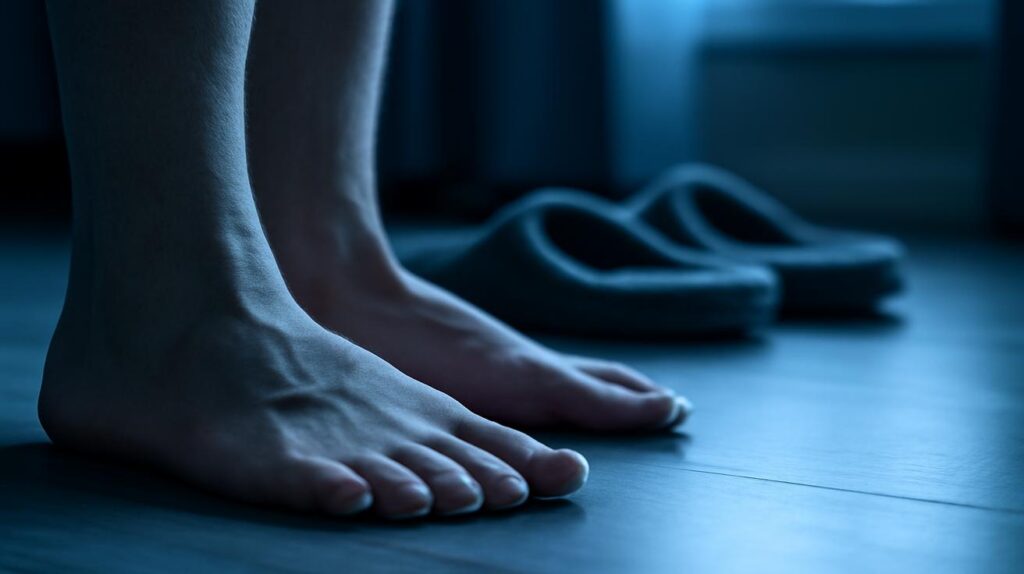
The first time you step barefoot onto a cold kitchen tile in the dark of a winter morning, the whole world shrinks to the size of your feet. There’s the brief, stunned pause—skin meeting stone, warmth meeting chill—and then the feeling rushes up your legs like a quiet alarm. Your breath catches. Somehow, impossibly, your toes are in charge of your entire body temperature. A moment ago you were fine. Now you’re shivering, hugging yourself in a room that hasn’t changed by even a single degree. What happened?
The Secret Weather Station in Your Feet
Your feet are not just lumps of bone and skin at the bottom of your body; they’re more like a built-in weather station—dense with nerves, rich with blood vessels, and constantly whispering reports to your brain about what’s happening down there on the ground. When you put them onto a cold floor, those sensors flare to life.
Most of us move through our homes without ever thinking about how much our feet are doing. They balance us over uneven carpets and hard tiles. They adjust to every tiny change in slope. At the same time, they’re making real-time temperature assessments, monitoring how much heat is flowing out of you and into whatever you’re standing on.
That cold floor, especially if it’s tile, stone, or concrete, acts like a sponge for heat. Your warm body is suddenly touching a surface that can pull heat away very quickly. The skin on your feet, thin and exposed, doesn’t have much insulation. Heat moves from your body into the floor, and the nerves in your feet send a blunt, urgent message upstairs: We are losing warmth. Fast.
Your brain listens. It doesn’t just notice the cold—it reacts to it. And that’s when things start to spread from toes to torso, from local chill to full‑body shiver.
The Runaway Heat Train: How Cold Floors Steal Warmth
Conduction, Circulation, and That Sudden Full-Body Shiver
The strange part about a cold floor is that it doesn’t feel neutral; it feels actively cold, as if it’s attacking your warmth. That’s physics at work. When your skin touches a much cooler surface, heat travels from the warm thing (you) to the cool thing (the floor). This is conduction—direct heat transfer between two objects in contact.
But this isn’t just about skin deep sensation. Blood is always moving through your feet, carrying heat along with it. When that warm blood flows into the capillaries near your cold-soaked skin, more heat is sucked away into the floor. Your body responds in its own quiet, survivalist way: it starts narrowing blood vessels in your feet and lower legs, trying to reduce the amount of heat escaping.
That narrowing—called vasoconstriction—has a cost. Less warm blood flows to your extremities, and more is conserved in your core, where your most vital organs live. It’s a clever survival move, but it also changes what you feel. Your toes tingle, your feet ache, your calves feel oddly stiff. Your brain blends all of those signals and says, We’re cold. Not just the feet; we, the whole body.
Sometimes, the reaction ramps up even further. Your muscles might start to shiver, not only where you feel the cold but in other parts of your body. Shivering is your body’s way of generating heat through rapid, tiny muscle contractions. What began as a simple barefoot step onto a chilly floor triggers a very real, whole-body thermoregulation response.
Why Your Brain Thinks Cold Feet Mean a Cold World
Perception, Protection, and the Story Your Body Tells Itself
Temperature is a slippery thing, because it’s not just a number; it’s an experience. You can sit in a 20°C (68°F) room and feel either perfectly comfortable or absolutely freezing, depending on what your body and brain are paying attention to.
Your feet are one of the closest parts of your body to the environment. They often meet the world without much protection—just a thin layer of sock, or nothing at all. When they sense cold, your brain doesn’t interpret it as a small, local issue. Instead, it adds it to a much bigger internal calculation: How safe are we? How much heat are we losing overall?
The signals from your feet carry more weight than you might think. They tell your brain about the “ground conditions” of your world. A warm floor reads as friendly environment. A cold floor reads as hostile environment, at least as far as body temperature is concerned. So, your brain errs on the side of caution. It ramps up your perception of cold throughout your whole body, nudging you toward behaviors that will keep you warm—put on socks, move, turn up the heat, seek a blanket, step away from that icy surface.
In a way, your body is a storyteller, constantly weaving a narrative out of scattered sensory details. Cold feet become a plot twist, causing the story to shift: you are no longer simply “a person walking across the kitchen.” You are suddenly “a person exposed to cold,” and the rest of your body gets cast into that role, whether it was actually cold to begin with or not.
Feet, Floors, and the Physics of Feeling Cold
Different Surfaces, Different Stories
Not all cold floors are created equal. Stand barefoot on a wooden floor in winter, then compare it with a ceramic tile, and you’ll notice something fascinating: even if they’re in the same room, one feels far colder than the other.
This has everything to do with how well a material conducts heat. Tile and stone are efficient heat thieves; they pull warmth away from your skin quickly. Wood, cork, and some laminates are more forgiving. They still take your heat, but they do it more slowly, making them feel less brutal even at the same temperature.
Consider this simple comparison:
| Floor Type | How It Feels on Bare Feet | Why It Feels That Way |
|---|---|---|
| Ceramic/Stone Tile | Very cold, almost shocking | High heat conduction pulls warmth away quickly. |
| Concrete | Steadily, deeply cold | Large thermal mass stores and absorbs heat. |
| Hardwood | Cool, but not biting | Lower heat conduction, some natural insulation. |
| Vinyl/Laminate | Mildly cool | Thin layer over subfloor; moderate conductivity. |
| Carpet/Rug | Warm or neutral | Fibers trap air and slow heat loss. |
When you step onto tile, the floor pulls heat away fast enough that your nerves send an urgent cold signal. On wood, the same room temperature might feel manageable because the heat trickles away more slowly. Your body has a bit more time to adjust, to move blood, to regulate without panicking.
The surface you stand on, in other words, changes the entire emotional climate of a room—without the thermostat ever moving.
From Toes to Immune System: The Bigger Picture of Being Cold
What Really Happens When Your Feet Stay Cold
There’s a long‑lived bit of folklore that says walking on cold floors with bare feet will give you a cold. The story has been passed from grandmother to grandchild for generations: “Put something on your feet or you’ll get sick.” Scientifically, viruses are what make you sick, not chilled toes, but there’s a small kernel of complexity hidden inside that old warning.
When your feet are cold for an extended period, your body remains in that subtle defensive state—blood vessels constricted, heat pulled toward the core. Some studies suggest that being cold, especially at the extremities, can slightly change how your immune system behaves, or how well blood circulates in the nose and throat, places where viruses love to land.
Cold feet alone won’t conjure a virus out of thin air. But if one is already lurking in your system, that chill might just tilt the balance a bit, making it easier for symptoms to bloom. It’s not a curse, just physiology doing its cautious little dance.
Meanwhile, on a more immediate level, cold feet create a constant background discomfort. You become less willing to move, less inclined to focus, more aware of your body as a place of minor suffering. It’s amazing how much mental space toes can occupy when they’re freezing.
Your body is always trying to make peace between comfort and survival, between warmth and energy use. Walking barefoot on a cold floor tips that balance, sending a whisper that sometimes builds into a shout: Protect the warmth. Do something.
Learning to Live With Cold Floors (Without Freezing)
Small Rituals that Change the Way You Experience Winter
There’s a quiet kind of intimacy in knowing how your home feels underfoot. The shock of that first cold step can also be an invitation: to understand your body better, to adjust your environment, to craft little rituals of warmth.
Simple choices can soften the entire experience. A rug beside the bed to catch your feet before they ever meet the bare floor. Soft socks waiting on a chair by the door. Slippers that turn a frigid hallway into a tolerable journey. None of these things actually raise your body’s core temperature much—but they profoundly change what your nerves report to your brain.
Sometimes, it’s also about timing and gradual exposure. If you know the floor will be cold, lingering on a mat for a moment, flexing your toes, or taking a few quick steps instead of standing still can help. Movement generates heat. Blood flows more vigorously. Your circulation wakes up and joins the negotiation.
For some, there’s a deeper curiosity in the barefoot experience itself. They might choose to walk briefly on a cold floor as a kind of grounding, a reminder of the season. In those moments, the shock becomes a deliberate sensation instead of an unwelcome surprise. The brain reads it differently: not as danger, but as chosen encounter.
In any case, the lesson is the same. The way you meet the floor, and the way the floor meets you, is a dialogue. Your nerves, your blood vessels, your muscles, your mind—they’re all listening.
Why That Small Patch of Skin Matters So Much
The Quiet Power of Extremities
When you zoom out, the idea that a few square inches of skin could make your whole body feel colder sounds almost unreasonable. But extremities—feet, hands, ears, nose—play an outsized role in how we experience the world.
They are where we encounter edges: the edge of the air, the edge of the water, the edge of the ground. They warn us about ice and heat, about sharp stones and burning sand, about surfaces that are safe to linger on and those we should leave immediately. Because of that, evolution has filled them with sensors, like a dense forest of tiny, watchful eyes.
So when your bare feet meet a cold floor, it isn’t just a minor, local inconvenience. It is your environment announcing itself through one of your most sensitive channels. Your body, acting out of deep habit and old wisdom, responds as if the whole world might be that cold, not just the floor. It tightens blood vessels, shifts warmth, primes muscles for shivering, and reshapes your moment‑to‑moment story into one of needing shelter.
The house around you may be calm and still. The thermostat might insist everything is fine. But in that fleeting instant when skin meets ice‑cool tile, your body remembers winter caves and open fields, wind‑scoured stone and snow‑cloaked ground. It doesn’t argue with the thermostat. It listens to your feet.
That’s why something as simple as walking barefoot on a cold floor can make your whole body feel colder: because feeling cold is not just a temperature reading—it’s a decision your body makes, based on the loudest voices it hears. And in the quiet, early hours, when you’re padding through a dim kitchen, those loudest voices are almost always your feet.
Frequently Asked Questions
Does walking on cold floors really lower my core body temperature?
Briefly walking on a cold floor usually doesn’t lower your core temperature very much. It mainly makes your skin and extremities colder, which your brain interprets as overall cold. Longer exposure, especially if the room is also cold, can contribute to a gradual drop in core temperature.
Can cold feet from bare floors make me sick?
Cold floors themselves don’t cause infections; viruses and bacteria do. However, being chilled can slightly affect circulation and the way your body responds to viruses that are already present, which might influence how symptoms develop.
Why do tile and stone floors feel colder than wood at the same temperature?
Tile and stone conduct heat much more efficiently than wood. They pull heat away from your skin quickly, so they feel much colder, even if a thermometer would show that both surfaces are at the same temperature.
Is it unhealthy to walk barefoot on cold floors regularly?
For most healthy people, short periods of walking barefoot on cold floors are more uncomfortable than harmful. People with circulation issues, diabetes, or nerve problems in their feet should be more cautious and talk with a healthcare professional about protecting their feet from cold.
What’s the easiest way to stop feeling so cold when I step on cold floors?
Layering between your skin and the floor helps the most: warm socks, slippers, or rugs where you stand often. Gentle movement—wiggling toes, walking rather than standing still—also boosts circulation and reduces that deep, lingering chill.